




The short answer
The City of North Vancouver plumbing permit application reproduces clause 1.2.3.1, which allows plumbing work by a certified plumber, by an apprentice under supervision, or by the registered owner and occupant or intended occupant of the single family dwelling where the work happens. That third route carries three conditions at once: your name on title, you live there or will live there, and the building is a single family dwelling.
The clause the City prints on its own permit form
The City of North Vancouver plumbing permit application (Form 1793944) reproduces clause 1.2.3.1, Personnel Performing Plumbing Work. The text reads: personnel performing the installation, extension, alteration, renewal or repair of a plumbing system shall (a) possess a Canadian tradesman's qualification certification as a plumber, (b) be an indentured apprentice supervised by a journeyman who meets the criteria set out in Clause (a), or (c) be the registered owner and occupant or intended occupant of the single family dwelling in which plumbing work will occur.
Two of those words need plain definitions before the rest of this makes sense. An indentured apprentice is a person registered in a formal training program, working under a qualified tradesperson while they learn. A journeyman is a tradesperson who has finished that training and holds the certificate, so they can work without supervision and can supervise others.
Route (a) is a certified plumber. Route (b) is an apprentice with a certified plumber watching the work. Route (c) is the homeowner route, and it is the one that gets quoted in conversation and misread in practice.
The District of North Vancouver states the same idea in shorter form in its published material. Its Outdoor Pool and Hot Tub Regulations (Master Requirement BLD 119) says only a licensed plumber or a qualified resident homeowner may obtain a plumbing permit. The word resident is doing the same job there as occupant does in the City's clause.
| Route | Who it covers | What it requires |
|---|---|---|
| (a) Certified plumber | A tradesperson holding the certificate | A Canadian tradesman's qualification certification as a plumber |
| (b) Supervised apprentice | A person still in training | Indentured apprentice status, supervised by a journeyman who meets Clause (a) |
| (c) Homeowner | The person who owns and lives in the house | Registered owner, plus occupant or intended occupant, plus a single family dwelling |
Three conditions in one sentence
Clause (c) reads like a single permission. It is three tests joined together, and you have to pass all of them at once.
Registered owner means the name on the land title. A tenant fails this test even with the landlord's blessing. So does a partner, an adult child, or a friend whose name is not on title. If the house is held in a company name, the person doing the work is not the registered owner, and the clause does not cover them.
Occupant or intended occupant means you live in the house now, or you are going to. An investor buying a house to fix and sell fails this test. So does an owner who lives elsewhere and is renovating a property they rent out. The word intended keeps the door open for someone who bought a house and is renovating before they move in, which is the common and legitimate case.
Single family dwelling is the condition that surprises people, because it describes the building rather than the person. The clause is written for one house holding one home.
- Your name is on the land title for that property.
- You live in the house, or you will live in it once the work is done.
- The building is a single family dwelling.
- The work is installation, extension, alteration, renewal or repair of a plumbing system.
What happens when a suite enters the plan
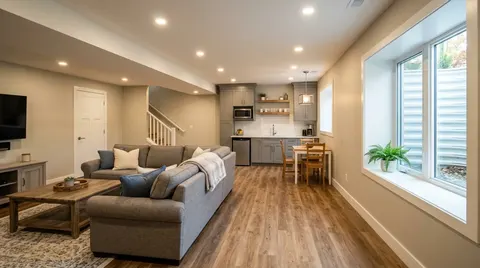
Once a second dwelling unit is part of the project, the third condition in clause (c) stops being automatic. A house being converted to hold a suite raises a real question: is it still the single family dwelling the clause describes, at the point where the plumbing work happens? That question has to be answered by the municipality, in writing, before any pipe is cut.
We are careful about how we say this, because the clause does not spell out the answer. It does not say a homeowner may never do plumbing work in a house containing a suite. It sets a condition, and a suite is exactly the situation where the condition needs confirming rather than assuming.
There is a signal worth knowing about from the other side of the North Shore. The District of North Vancouver, in the same published document, writes that a homeowner can only do electrical work if there is no secondary suite. That is a different trade and a different municipality, so it does not decide the plumbing question. It shows that municipalities do attach suite-related limits to homeowner permits, which is the reason to ask instead of guessing.
The cost of asking is one email. The cost of guessing wrong is a stop work order partway through, a permit that has to be redone by a certified plumber, and work that may have to be opened up again for inspection. The City's Building department is at 141 West 14th Street, North Vancouver. In the District, the Building Department answers at 604-990-2480 and building@dnv.org.
Ask the question with the full picture in it: the address, that the house will contain a secondary suite, which parts of the plumbing you plan to do yourself, and who will do the rest. Keep the reply.
The permit is priced from a count, so the count matters
The City of North Vancouver application does not ask for a project value and stop there. It asks for a fixture count and a piping length, and the permit follows from those numbers. A fixture is a plumbing device that uses water or takes waste away, such as a toilet, a sink, or a shower.
The form lists the fixture types to be counted and asks for a total fixture count: water closet, lavatory basin, bath tub, shower, clothes washer, sink, dishwasher, fridge box, pot filler, water heater, bidet, floor drain, sanitary pump, oil or grease interceptor, urinal, drinking fountain, eyewash, mop sink, man hole or sump, catch basin, deck drain, roof drain, area drain, trench drain, hub drain, backflow prevention, and other.
Several of those are items people forget they have. A fridge box is the water line and the recessed box in the wall that feeds an ice maker or a water dispenser in a refrigerator. A pot filler is the folding tap mounted on the wall above a stove. Backflow prevention is a device that stops water from flowing backwards from your house into the drinking water supply, which matters on irrigation lines and some appliances.
The form also asks for piping length in metres, broken into three categories with a total: water pipe, DWV, and storm. DWV stands for drain, waste and vent, which covers the pipes that carry waste water out of the house and the vent pipes that let air in so the drains run properly. Storm pipe carries rainwater.
This is why a whole-house repipe and one bathroom are not priced alike. A repipe means replacing all the supply piping in a house, so the pipe length is large across the whole building while the fixture count may barely move. A bathroom renovation can add fixtures with a short run of new pipe. Two projects, two different shapes on the same form.
- Clothes washer, which people count as an appliance rather than a fixture.
- Dishwasher, for the same reason.
- Fridge box, the water line and wall box feeding a refrigerator.
- Pot filler, the tap above the stove.
- Water heater, which is on the list in its own right.
- Floor drains in a laundry room, mechanical room or garage.
- Backflow prevention devices, including on irrigation.
- Hub drains, area drains and trench drains, which show up on older North Shore houses with long driveways and heavy rain runoff.
What else the application asks for
The rest of the form is short, and each part tells you something about how the City reviews the work. It asks whether this is a new plumbing permit or a revision to an existing permit number, the site address and unit number, and the building permit number where one applies. That last field is the link between the plumbing work and the wider renovation, so keep the building permit number to hand.
Applicant information separates a personal applicant from a company or business. There is a Contractor Certification block asking for Trade Qualification and Business Licence number. A homeowner going the clause (c) route is filling in the personal side of that page.
There is a written Description of Installation. Write it as the work actually is, in plain sentences. Replace all galvanized supply piping on two floors, add one new bathroom group on the lower floor, relocate the laundry. An accurate description costs nothing and prevents a revision later.
The form states that the permit will be issued when all the conditions and requirements of City Bylaws and codes are met. Plumbing is Part 7 of the BC Building Code, which the District of North Vancouver refers to as the Plumbing Code (Part 7 of the BCBC). The permit is the municipality confirming the work is going to meet that code, then checking at each inspection that it did.
We do not publish fee figures here, because fee schedules change and each municipality sets its own. Ask the City or District for the current plumbing fee schedule before you budget, and ask how the fixture count and pipe length feed into it.
The inspection sequence is your real schedule
The City's form asks the applicant to request inspections, with checkboxes for DWV rough-in, water rough-in, DWV underground, water service, tub or shower, and final. Rough-in means the stage where pipes are run and connected but the walls, floors and ceilings are still open.
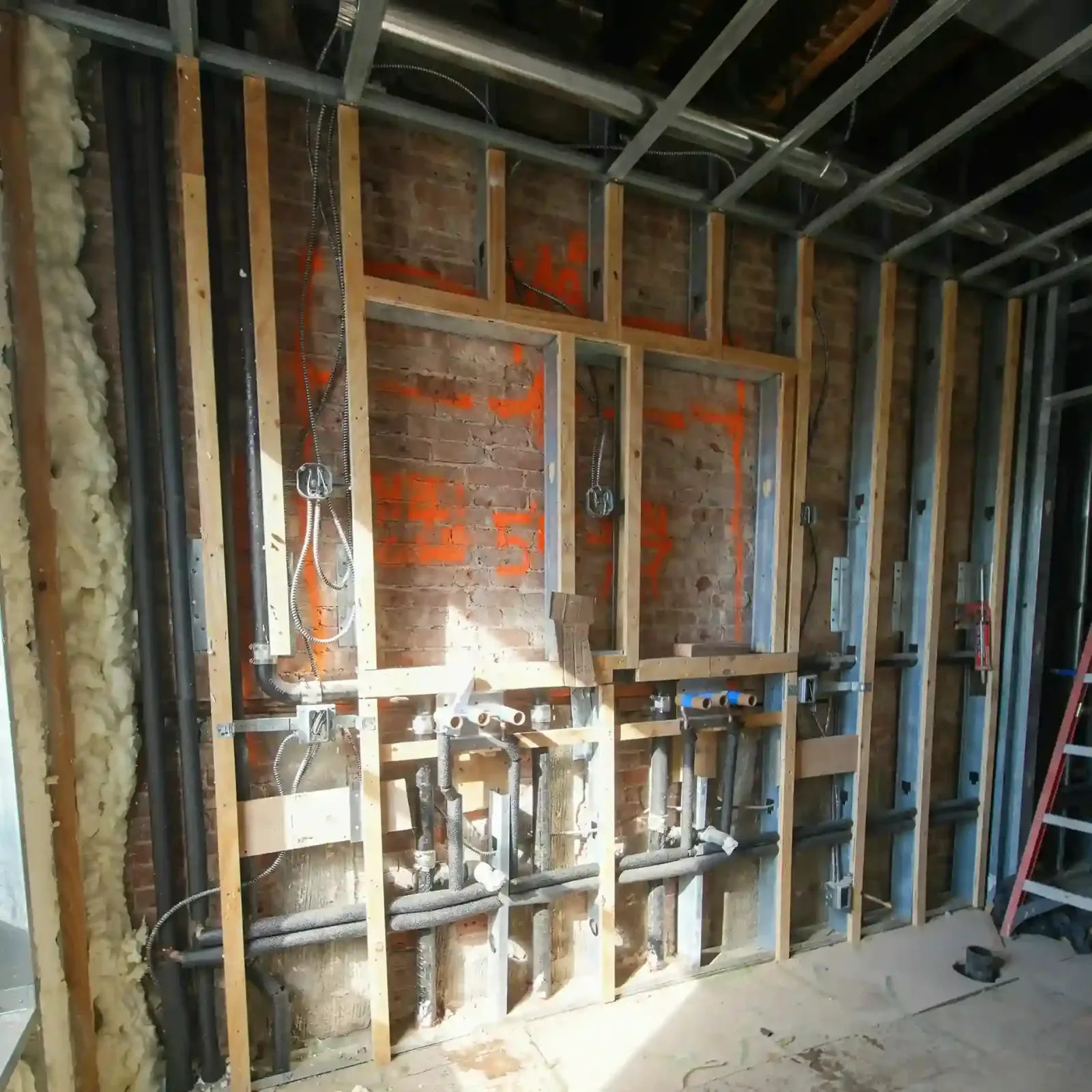
DWV underground covers drain, waste and vent pipe that runs below a concrete slab. It is inspected before the pipe is buried or the slab is poured. Once concrete is over it, the only way to show the inspector the work is to break the concrete.
DWV rough-in and water rough-in cover the drain and supply pipes inside the walls and floors, inspected before anything closes them in. Water service is the supply line that runs from the street connection into the building. Tub or shower covers the pan and its connections before tile and finishes go on.
One rule governs the whole timeline: nothing gets covered before it has been inspected. That single rule decides your trade sequence. Drywall cannot be booked on the assumption the inspection will pass. Insulation waits. Tile waits for the tub or shower inspection. The concrete pour waits for the underground inspection.
On our projects the inspection dates go on the schedule before the trades do, with a gap on either side. A repipe in an occupied house is the version that hurts most when this is done backwards, because the family is living without water for longer than they were told.
| Inspection | What it looks at | What cannot happen first |
|---|---|---|
| DWV underground | Drain, waste and vent pipe running below a slab | Backfill or concrete pour over the pipe |
| Water service | The supply line from the street connection into the building | Covering or backfilling the trench |
| DWV rough-in | Drain and vent pipe inside walls and floors | Insulation, drywall, floor sheathing over the runs |
| Water rough-in | Supply pipe inside walls and floors | Insulation and drywall |
| Tub or shower | The pan and its connections | Tile, board and finishes |
| Final | The finished plumbing system in use | Treating the job as closed |
Why older North Shore houses turn a small job into a repipe
A repipe means replacing the supply piping through the whole house rather than patching one run. It gets on the table in older houses for a simple reason: the walls are already open.
Two materials come up again and again on the North Shore. Galvanized steel supply pipe, used in older houses, is steel pipe with a zinc coating. Polybutylene, a grey flexible plastic supply pipe used in a later period, is the other one owners commonly choose to replace during a renovation. When either is found behind a wall that is already open, the question changes from whether to replace it to whether to replace it now or pay to open the wall again later.
The arithmetic is plain. Demolition, access and making good are a large share of what a repipe costs. When a renovation has already paid for those, the added cost of continuing the new pipe through the rest of the house is smaller than starting from a finished house on a separate job.
This is also the point where the permit paperwork changes shape. A bathroom renovation that becomes a repipe adds a large number of metres to the water pipe field on the form, and the description of installation needs rewriting. Do that before the work, rather than as a revision after an inspector notices the scope on site.
Allowed and advisable are two separate questions
Clause (c) settles whether you may take out the permit. It says nothing about whether you should do the work yourself.
The inspection sequence applies to a homeowner permit the same way it applies to a plumber. You still book each inspection, you still leave the work open until it passes, and a failed inspection still stops the trades behind you. A homeowner doing this around a full-time job is the most common source of a schedule that slips by weeks.
Insurance is worth checking before you start. Water damage claims turn on how the plumbing was installed and whether the work was permitted and inspected. Call your insurer and ask what they need, and keep the permit and the inspection records with your house documents.
Resale raises the same paperwork. A buyer's agent asks whether the work was permitted, and the municipality keeps a record of permits and inspections on the property file. An unpermitted repipe is a question you will answer at the worst possible moment, in the middle of a sale.
A middle path works well. Some owners take out the permit for work they will genuinely do, and hire a certified plumber for the parts that carry the most risk, such as the water service and anything under a slab. Where a suite is in the plan, we ask the municipality first and build the answer into the schedule, because a suite changes the plumbing, the electrical, and the inspection list at the same time.
The three North Shore municipalities are three processes
The City of North Vancouver, the District of North Vancouver, and the District of West Vancouver each issue their own plumbing permits, with their own forms, their own fee schedules, and their own conditions. A neighbour's experience two streets away can come from a different municipality with a different answer.
The City publishes the plumbing permit application quoted throughout this post, with clause 1.2.3.1, the fixture list, and the piping length fields. Its privacy notice gives the City address as 141 West 14th Street, North Vancouver, BC V7M 1H9.
The District of North Vancouver states in published material that only a licensed plumber or a qualified resident homeowner may obtain a plumbing permit, and its Building Department can be reached at 604-990-2480 or building@dnv.org.
For a property in West Vancouver, confirm requirements with the District of West Vancouver directly. We are not going to describe their process from memory, and neither should anyone else planning a budget around it.
Sources
- City of North Vancouver, Plumbing Permit Application (Form 1793944). Reproduces clause 1.2.3.1, Personnel Performing Plumbing Work, with the certified plumber, supervised indentured apprentice, and registered owner and occupant of a single family dwelling routes. Also establishes the required fixture count with its full fixture list, the piping length fields for water pipe, DWV and storm with a total, the description of installation, the inspection request checkboxes, the contractor certification block, the statement that the permit will be issued when all conditions and requirements of City Bylaws and codes are met, and the City address at 141 West 14th Street, North Vancouver, BC V7M 1H9.
- City of North Vancouver, Plumbing, Gas and Sprinkler Permits. The City page that hosts the plumbing permit application forms and the related permit information.
- District of North Vancouver, Outdoor Pool and Hot Tub Regulations (Master Requirement BLD 119). Establishes that only a licensed plumber or a qualified resident homeowner may obtain a plumbing permit in the District, that a homeowner can only do electrical work if there is no secondary suite, that plumbing is Part 7 of the BC Building Code, and gives the Building Department contact as 604-990-2480 and building@dnv.org.
Frequently asked questions
Can I pull my own plumbing permit in North Vancouver?
Clause 1.2.3.1, printed on the City of North Vancouver plumbing permit application, allows plumbing work by the registered owner and occupant or intended occupant of the single family dwelling where the work will occur. You need all three at once: your name on title, you live there or will live there, and the building is a single family dwelling. The District of North Vancouver describes the same route as a qualified resident homeowner.
Does a secondary suite stop me from doing my own plumbing?
The clause does not say so directly, and we will not claim it does. It requires a single family dwelling, and adding a second dwelling unit puts that condition in question. Confirm your eligibility with your municipality in writing before starting. The District of North Vancouver publishes a suite limit for homeowner electrical work, which shows municipalities do apply suite-related restrictions to homeowner permits.
What does registered owner mean on the permit form?
It means the person named on the land title for that property. A tenant does not qualify, even with the landlord's permission. A family member whose name is not on title does not qualify. Where the house is held in a company name, the person doing the work is not the registered owner, so the homeowner route in clause (c) does not cover them.
I bought the house but have not moved in yet. Does that count?
Clause (c) says registered owner and occupant or intended occupant. The words intended occupant are written for exactly that case: you own the house and you are going to live in it once the work is done. An owner who will never live in the property, such as an investor renovating to sell or to rent out, does not meet that condition.
How much does a plumbing permit cost in North Vancouver?
We do not publish a figure, because fee schedules change and each municipality sets its own. What we can tell you is how the number is built: the City's application asks for a total fixture count and a total piping length in metres, split into water pipe, DWV and storm. Ask the City or District for the current plumbing fee schedule before you budget.
What counts as a fixture on the application?
The City form lists water closet, lavatory basin, bath tub, shower, clothes washer, sink, dishwasher, fridge box, pot filler, water heater, bidet, floor drain, sanitary pump, oil or grease interceptor, urinal, drinking fountain, eyewash, mop sink, man hole or sump, catch basin, deck drain, roof drain, area drain, trench drain, hub drain, backflow prevention, and other. Washers, dishwashers and water heaters are on that list, which people miss.
What is a fridge box and a pot filler?
A fridge box is the water line and the small recessed box in the wall behind a refrigerator that feeds an ice maker or a water dispenser. A pot filler is the folding tap mounted on the wall above a stove so you can fill a pot in place. Both appear on the City's fixture list, so both belong in your total fixture count.
What does DWV mean on the permit form?
DWV stands for drain, waste and vent. It covers the pipes that carry waste water out of the house and the vent pipes that let air into the system so the drains run properly. The City form asks for DWV piping length in metres as one of three categories, along with water pipe and storm, plus a total pipe length.
Which inspections do I have to book on a plumbing permit?
The City form lists DWV rough-in, water rough-in, DWV underground, water service, tub or shower, and final. Underground covers pipe below a slab, inspected before it is covered. Rough-in covers pipe in walls and floors before they are closed. Water service is the supply line into the building. Tub or shower covers the pan and connections before finishes.
Can I close the walls before the inspector comes?
No. Nothing may be covered before it has been inspected. That rule sets the whole schedule: drywall, insulation, tile and any concrete pour all wait for their inspection to pass first. Covering work early means opening it again, which costs more than the delay you were trying to avoid. Put inspection dates on the schedule before you book trades.
Should I repipe the whole house while the walls are open?
It is worth pricing both ways. Demolition, access and repair of finishes are a large share of a repipe cost, and a renovation has already paid for them where the walls are open. Older North Shore houses often have galvanized steel or polybutylene supply pipe, which owners commonly choose to replace at that point rather than reopen finished walls later.
Do the same rules apply in West Vancouver?
Each North Shore municipality issues its own plumbing permits with its own forms, fees and conditions. Everything quoted here about the fixture count, the piping length fields and clause 1.2.3.1 comes from the City of North Vancouver's application. For a West Vancouver property, confirm the requirements with the District of West Vancouver directly before you plan or budget.
Related service
Home renovation
See how we handle home renovation projects across the North Shore.
Learn about home renovationWhere this applies
Related articles