

The short answer
Waterfront renovation in West Vancouver costs more because of salt-air detailing, wind-rated glazing, and foreshore rules. Substantial whole-home renovation runs $250 to $350 per square foot, cosmetic work $80 to $140, with marine-grade fasteners, hardware, and coatings, plus below-road access costs and environmental approvals added on top of those base rates.
What counts as waterfront here
Waterfront in West Vancouver is wider than the row of houses touching the sand. The District's Foreshore Development Permit Area, adopted in April 2022, covers roughly 780 low-lying properties between Ambleside and Horseshoe Bay, and it includes upland lots that sit below the flood construction level, not just those with tide against the seawall. Plenty of owners a street back from the water are inside it without knowing.
The exposure zone is wider still. Salt-laden air does not stop at the first row of houses. We see salt-driven corrosion on hardware and flashings several lots uphill from the beach, especially where the shoreline faces open water toward the strait rather than a sheltered bay. For detailing purposes, we treat anything within sight and smell of the water as a marine environment.
Salt: the slow fire
Salt is the defining condition of waterfront work, and it attacks the cheap details first. Standard galvanized fasteners, hangers, and flashings that last decades inland pit and streak within a few years on the waterfront. The fix is specification, not maintenance: stainless steel fasteners and hangers on exposed structure, aluminum or stainless flashings rather than galvanized steel, and hardware rated for marine exposure on everything from gate hinges to light fixtures.
Cladding and coatings follow the same logic. Cedar performs well near the water when it is detailed to dry and finished on all six sides before installation. Steel components want marine-grade coatings. Exterior metalwork, rails, and window hardware should be chosen on the assumption that salt fog will find every unprotected surface. None of this is exotic, but it has to be in the specification and the budget from the start, because upgrading fasteners after the cladding is on is not a job anyone enjoys pricing.
Glazing is the other salt casualty. Waterfront windows carry a constant film of salt spray, and original 1960s and 1970s aluminum frames with failed seals are standard findings on this stock. Envelope and window replacement on West Vancouver view homes runs $150,000 to $400,000 depending on glazed area, and on the waterfront the marine-grade hardware and coastal wind ratings sit at the top of that band.
Wind and rain arrive horizontally
A waterfront wall does not get rained on, it gets sprayed. Southeast storms drive rain horizontally against the seaward elevations, and the wall assemblies that survive are the ones detailed like boat decks: generous flashings, drained and vented rain screen cavities, sealed penetrations, and windows installed with proper sill pans rather than caulking and optimism.
Wind load is a structural input, not just a comfort issue. Exposed shoreline sites see gusts that inland streets never do, and that shows up in engineering for big glazed openings, doors, and roof edges, and in the hold-down detailing on decks and overhangs. When we replace a window wall on the waterfront, the engineering conversation covers wind pressure ratings that would be irrelevant three kilometres uphill. West Vancouver already gets over 1,500 millimetres of rain a year; the waterfront simply delivers more of it sideways.
The foreshore rules, and what they require
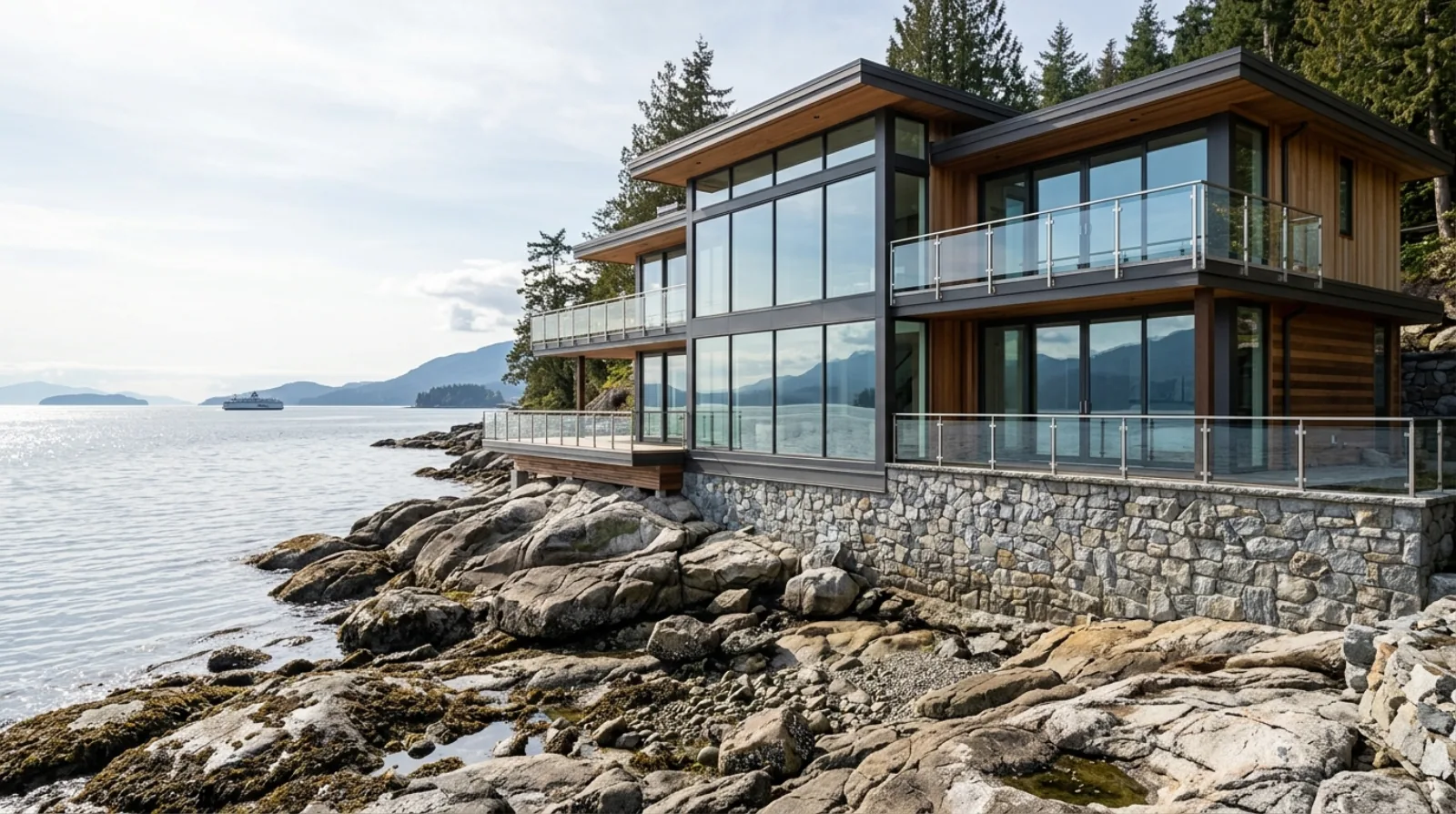
The Foreshore Development Permit Area exists for two stated reasons: protecting people and homes from coastal flooding as sea levels rise, and protecting the intertidal habitat along the shore. For renovation and redevelopment inside the area, the practical requirements flow from the District's foreshore protection guidelines, including the one owners feel most: habitable space must be built up to the flood construction level. On a low bench lot, that single elevation requirement can reshape a whole design, from garage placement to how many steps lead to the front door.
Trees along the shore have their own permit stream within the foreshore protection area, so removing shoreline vegetation runs through an application, not a chainsaw decision. And where work approaches the beach itself, seawalls, stairs to the water, anything at the high-tide line, additional approvals beyond a standard building permit come into play. Our advice is unglamorous: get the District's mapping for your specific lot before any design work, because the flood construction level and the permit area boundary are facts about your property, not negotiating positions.
Creeks, riparian setbacks, and the QEP
Dozens of creeks cross West Vancouver on their way to the sea, and waterfront lots sit at the bottom of that drainage, so creek mouths and channels are common on and beside these properties. The District requires an environmental development permit for development within 15 metres of the top of bank of a watercourse, and it publishes a typical processing time of four to six weeks for a complete application.
The provincial layer is the Riparian Areas Protection Regulation, which defines a riparian assessment area of 30 metres on each side of a stream. Development inside it requires an assessment by a qualified environmental professional, and the municipality cannot approve the application until that report is done and accepted. On a waterfront lot with a creek along one property line, the buildable area can be pinched from two directions at once, water in front and riparian setback on the side, which is exactly the kind of constraint you want mapped before the architect starts, not after.
The old waterfront cottages
Some of the most charming buildings on this shoreline are also the most fragile. West Vancouver began as a summer cottage community, and survivors from the 1910s to 1940s still sit along the waterfront benches, the District's own heritage records include 1920s cottages in both Ambleside and Dundarave. A century of salt and storms has usually been hard on them.
The findings mirror what we cover in our Ambleside and Dundarave character home guide, amplified by exposure: shallow foundations never engineered for today's loads, knob-and-tube wiring, galvanized plumbing, and framing that has been wet and dried more times than anyone can count. Budget accordingly: a full rewire runs $15,000 to $30,000, a replumb $10,000 to $20,000, and foundation work anywhere from $15,000 to $30,000 for waterproofing up to $80,000 to $150,000 or more for full replacement. On pre-1950 waterfront buildings we carry a 20 percent contingency without apology.
The flood construction level adds a question these cottages never had to answer: a renovation that keeps the building may live with its existing floor elevation, but substantial redevelopment inside the foreshore area has to meet the current requirement. Which path applies to your project is a conversation to have with the District early, because the answer can decide whether the cottage is renovated or replaced.
Access from the Marine Drive benches
Marine Drive is the construction artery for the whole shoreline, and most waterfront lots hang below it on benches reached by steep, narrow driveways, some shared, some barely a car wide. That geometry runs the logistics. Concrete pumps with long booms reach down from the road. Crane trucks lift windows and beams over the house rather than carrying them around it. Materials stage in small batches because there is nowhere to put a full delivery.
Working below the road also means working in a neighbourhood that takes site conduct seriously. The District enforces its noise bylaw, parking on Marine Drive is limited, and neighbours notice everything. We sequence deliveries tightly, keep the road clear, and plan the crane days well ahead, because on these lots a missed lift window is a lost week. Access is also a line in the budget: like the rest of steep West Vancouver, add 5 to 10 percent for access and staging, and more where everything must come over the top of the house.
What waterfront renovation costs, honestly
The base rates are West Vancouver's: $250 to $350 per square foot for substantial whole-home renovation, $80 to $140 for cosmetic scope, kitchens commonly $120,000 to $250,000, and primary bathrooms $60,000 to $120,000. The waterfront adds its own lines on top: marine-grade fasteners, hardware, and coatings across the envelope, wind-rated glazing, the elevated cost of working below the road, and the soft costs of foreshore and environmental approvals with their reports and review time.
Sequencing protects the budget more than any single specification decision. European window packages already run 12 to 16 weeks of lead time, so glazing gets ordered early. Permit layers get mapped before design so the flood construction level and any riparian setback shape the plan from day one. And the envelope gets priority over the finishes, because on the waterfront a beautiful kitchen behind a leaking wall is a temporary kitchen. The water is why you bought the house. Detail the building like it knows that.
Sources
Frequently asked questions
What is the Foreshore Development Permit Area in West Vancouver?
It is a development permit area the District adopted in April 2022 covering roughly 780 low-lying properties between Ambleside and Horseshoe Bay, created to manage coastal flood risk and protect intertidal habitat. It includes upland lots below the flood construction level, not just properties touching the water, so owners a street back from the beach can be inside it without realizing.
What is a flood construction level and how does it affect a waterfront renovation?
The flood construction level is the elevation the District requires habitable space to be built up to within the foreshore area, as protection against coastal flooding and sea level rise. On a low bench lot it can reshape the whole design, from garage placement to entry stairs. A renovation that keeps the existing building may live with its current floor elevation, but substantial redevelopment has to meet the requirement, so confirm which path applies with the District early.
What fasteners and hardware should a West Vancouver waterfront renovation use?
Stainless steel fasteners and hangers on exposed structure, aluminum or stainless flashings instead of galvanized steel, and marine-rated hardware on everything from gate hinges to light fixtures. Standard galvanized components that last decades inland pit and streak within a few years in salt air, and the exposure zone extends several lots uphill from the beach, especially facing open water.
Do riparian rules apply to waterfront properties in West Vancouver?
Often, yes, because creek mouths and channels commonly cross or border waterfront lots. The District requires an environmental development permit for development within 15 metres of a watercourse's top of bank, with a published typical processing time of four to six weeks. Provincially, the Riparian Areas Protection Regulation defines a 30 metre assessment area on each side of a stream, and a qualified environmental professional's report is required before the municipality can approve development inside it.
How does access work on waterfront lots below Marine Drive?
Most waterfront lots hang below Marine Drive on benches reached by steep, narrow driveways, so concrete pumps reach down from the road, crane trucks lift windows and beams over the house, and materials stage in small batches. Budget 5 to 10 percent extra for access and staging, more where everything comes over the top of the house, and plan crane days ahead because a missed lift window costs a week.
What does it cost to renovate a waterfront home in West Vancouver in 2026?
The base West Vancouver rates apply: $250 to $350 per square foot for substantial whole-home renovation and $80 to $140 for cosmetic scope, with kitchens commonly $120,000 to $250,000 and primary bathrooms $60,000 to $120,000. The waterfront adds marine-grade envelope specification, wind-rated glazing, below-road access costs, and the soft costs of foreshore and environmental approvals on top of those bands.
Why do waterfront windows in West Vancouver fail sooner?
They carry a constant film of salt spray, take rain driven horizontally by southeast storms, and see wind loads inland windows never meet. Original 1960s and 1970s aluminum frames with failed seals are standard findings on this stock. Envelope and window replacement on West Vancouver view homes runs $150,000 to $400,000 depending on glazed area, with marine-grade hardware and coastal wind ratings at the top of the band, and European packages carry 12 to 16 weeks of lead time.
Can I remove trees along the shoreline of my West Vancouver property?
Not without a permit. Tree removal within the foreshore protection area has its own permit stream under the District's tree rules, separate from the general Tree Bylaw thresholds, and trees over 10 centimetres within 15 metres of a watercourse are protected as well. Shoreline vegetation is treated as part of the intertidal habitat the foreshore rules exist to protect, so plan on an application, not a chainsaw decision.
What turns up in a 1920s West Vancouver waterfront cottage renovation?
Shallow foundations never engineered for modern loads, knob-and-tube wiring, galvanized plumbing, and framing cycled wet and dry for a century of storms. Budget $15,000 to $30,000 for a full rewire, $10,000 to $20,000 for a replumb, and anywhere from $15,000 to $30,000 for foundation waterproofing up to $80,000 to $150,000 or more for full replacement. We carry a 20 percent contingency on pre-1950 waterfront buildings.
How is wind handled differently on a waterfront renovation?
As a structural input, not a comfort issue. Exposed shoreline sites see gusts inland streets never do, which shows up in the engineering for large glazed openings, doors, roof edges, and the hold-down detailing on decks and overhangs. Replacement window walls on the waterfront are specified to wind pressure ratings that would be irrelevant a few kilometres uphill, and seaward wall assemblies are detailed with rain screens, sill pans, and sealed penetrations to handle rain arriving horizontally.
Am I in the foreshore area if my West Vancouver home does not touch the water?
Possibly. The Foreshore Development Permit Area includes upland properties below the flood construction level, not just lots on the water, and it covers roughly 780 properties from Ambleside to Horseshoe Bay. The boundary and the flood construction level are mapped facts about each specific lot, so request the District's mapping for your property before starting any design work.
What should be ordered first on a waterfront renovation schedule?
Glazing. European window packages run 12 to 16 weeks of lead time, and on the waterfront the windows carry wind ratings and marine hardware that cannot be substituted from local stock at the last minute. We order glazing early, map the foreshore and riparian layers before design, and prioritize the envelope over interior finishes, because a beautiful kitchen behind a leaking seaward wall does not stay beautiful long.
Related service
Home Renovation in West Vancouver
See how we handle home renovation in west vancouver projects across the North Shore.
Learn about home renovation in west vancouverRelated articles