

The short answer
Rigid-core SPC vinyl plank is the best all-round choice for a Vancouver basement: waterproof, does not swell, and survives a plumbing leak, at $8 to $14 per square foot installed. Porcelain tile with an uncoupling membrane performs even better but costs $14 to $28 per square foot and needs added heat to stay warm underfoot. Solid hardwood and broadloom carpet are not recommended below grade in this climate.
Why below grade is a different problem
A concrete slab is never truly dry. Even a slab with no visible water is passing moisture vapour upward from the soil beneath it, continuously, forever. In the Lower Mainland, where the soil rarely gets a chance to dry out between October and April, that vapour drive is stronger than in most of Canada.
The industry measures this with a calcium chloride test or a relative humidity probe. Anything over about 75% RH in the slab is a problem for glued flooring and for any organic material. Most North Shore basements we test come in between 75 and 90% unless there's a functioning vapour barrier under the slab, and homes built before the mid-1980s frequently have no under-slab barrier at all.
That single fact rules out more flooring choices than anything else. Solid hardwood is out. Standard engineered hardwood is a bad bet. Anything with a paper or wood-fibre core will eventually swell.
Luxury vinyl plank: the honest default
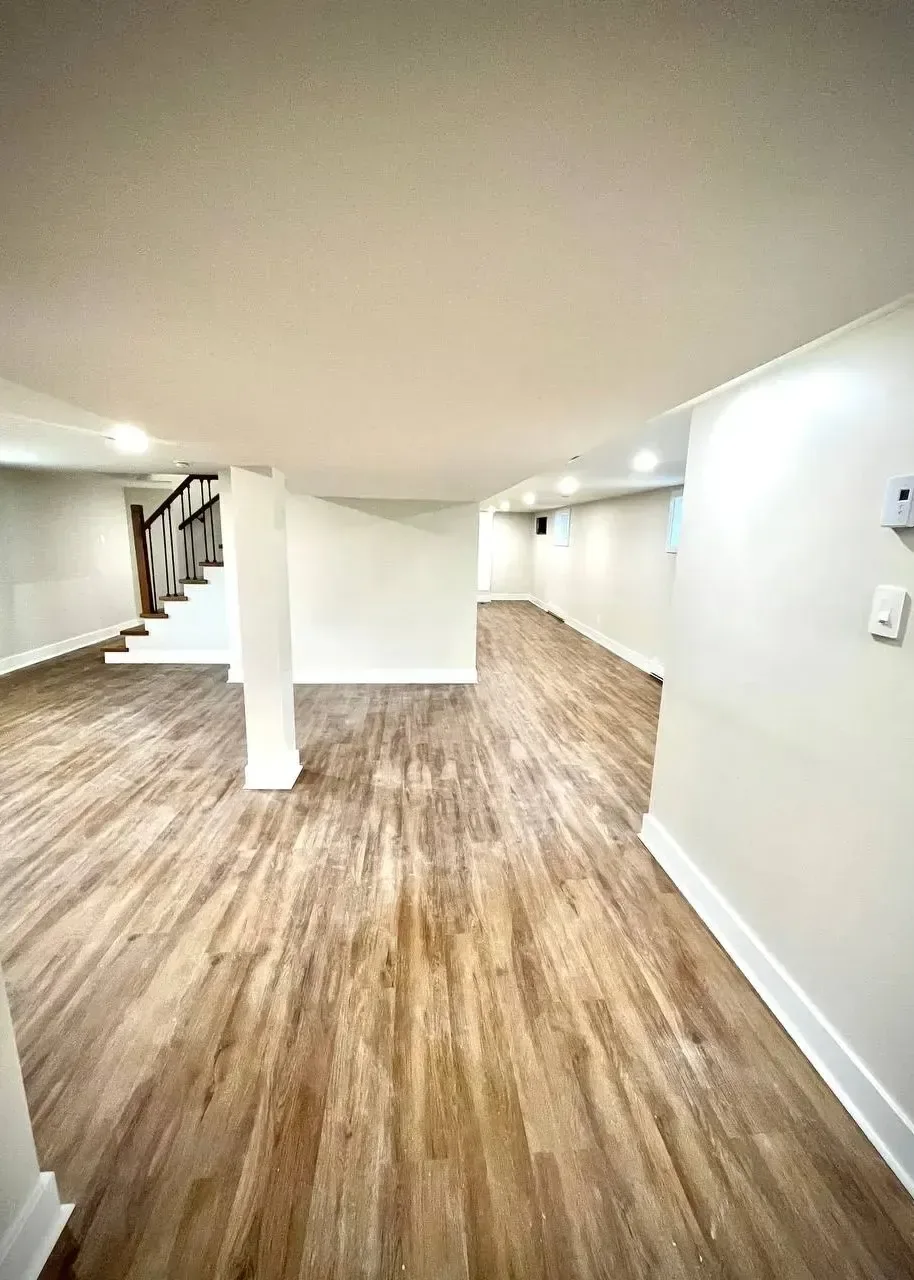
Rigid-core luxury vinyl plank, specifically SPC (stone plastic composite), is what we install in most North Shore basements, and it's what we'd put in our own. The core is limestone powder and PVC. It doesn't absorb water, doesn't swell, and doesn't feed mould. If a supply line lets go, you pull the planks, dry the slab, and put the same planks back down.
It runs $4 to $9 per square foot supplied, and $3 to $5 per square foot to install over a prepared slab. On an 800 square foot basement that's $5,600 to $11,200 all in.
The two things worth paying for are wear layer thickness and plank width. Anything under 12 mil of wear layer will show traffic patterns within five years in a family space. And wide planks over 8 inches telegraph slab irregularities more than narrow ones, so if the slab has a hump in it, either grind it flat or go narrower.
The knock against vinyl used to be that it looked like vinyl. That hasn't been true for about six years. The embossed-in-register products now line the surface texture up with the printed grain, and at normal standing distance in a finished room, most people can't tell.
Porcelain tile: the best performance, at a price
Nothing outperforms porcelain below grade. It's fired clay with a water absorption rate under 0.5%, it bonds directly to the slab with modified thinset, and it will still be there in forty years. If the basement floods, the tile does not care.
Installed cost runs $14 to $28 per square foot on the North Shore including uncoupling membrane, which is roughly double vinyl. That membrane matters more than the tile choice, because concrete slabs move seasonally with moisture and temperature, and a membrane like Ditra decouples the tile from that movement. Skipping it is why you see cracked grout lines running in a straight line across older basement floors.
Tile is cold. In a Deep Cove or Lynn Valley basement with a north-facing exposure, that's a real comfort issue, and it's the main reason we don't default to it. Electric in-floor heating mats add $12 to $20 per square foot installed and turn the coldest room in the house into the warmest, but now you're at $30 to $45 per square foot for the floor assembly, which is a real budget decision.
Where tile makes unarguable sense: basement bathrooms, laundry rooms, mudrooms coming in from a walkout, and any area near a hot water tank or mechanical equipment.
Engineered hardwood: what we tell clients who want it anyway
People love wood. We understand. But engineered hardwood below grade in this climate is a calculated risk, not a safe choice, and anyone who tells you otherwise is selling flooring.
If you're going ahead regardless, the requirements are non-negotiable. Test the slab first and get a written moisture number. Install a proper vapour retarder, either a sheet membrane or a two-part epoxy moisture barrier applied to the slab. Use a product with a plywood core, not HDF, and a minimum 3 mm wear layer. Float it rather than gluing it. And accept that a plumbing failure means the whole floor comes out, not a section.
Even done correctly you're looking at $12 to $22 per square foot installed with the moisture mitigation included. That's tile money for a material that performs worse below grade. We've replaced two engineered floors in North Vancouver basements in the past three years, both installed by other companies, both failed at the seams within four years. Neither had a moisture barrier.
Carpet and the subfloor question
Broadloom carpet directly on a basement slab is the one option we'll actively argue against. Carpet backing and pad are organic enough to support mould, they hold water for days, and they sit in exactly the location where the moisture is. A wet carpet in a basement is a remediation job, not a cleaning job.
Carpet tile is a different story and worth knowing about. Modular tiles with a closed-cell backing sit above the slab, don't wick, and can be lifted individually to dry. For a basement gym, a kids' play area, or a media room where you want softness underfoot, it's a reasonable choice at $6 to $12 per square foot installed.
The other approach is a dimpled subfloor panel system, DRIcore being the common one. Plastic dimples create an air gap over the slab, an OSB layer goes on top, and your finish floor goes over that. It gives you warmth underfoot and a break from slab moisture. The cost is $3 to $5 per square foot on top of your flooring, and about three quarters of an inch of ceiling height, which on a basement that's already at 7 feet is a real trade-off. Measure before you commit.
- SPC vinyl plank: best all-round choice, $8 to $14 per sq ft installed
- Porcelain tile with uncoupling membrane: best performance, $14 to $28 per sq ft
- Polished or sealed concrete: durable and cheap at $6 to $12 per sq ft, cold and unforgiving underfoot
- Carpet tile: comfortable and recoverable, $6 to $12 per sq ft
- Engineered hardwood: possible with full moisture mitigation, $12 to $22 per sq ft, still a risk
- Solid hardwood, laminate with HDF core, broadloom carpet: not recommended below grade in this climate
What has to happen before any flooring goes down
Every failed basement floor we've been called in to replace failed for the same reason: someone skipped the slab prep. The finish material was rarely the problem.
Start with the water. If there is any history of moisture, sort out perimeter drainage and grading before flooring is even discussed. Then test the slab and write the number down. Then grind or self-level any variation over 3 mm across a 3 metre span, because both tile and rigid vinyl telegraph unevenness and neither will sit flat over a wavy slab.
Seal any cracks with a flexible epoxy. Confirm the slab is clean of old adhesive, curing compound, and paint. And leave the material in the room for at least 48 hours before installation so it reaches equilibrium with the space, which matters more here than in a dry climate because the humidity swing between a sealed warehouse and a North Shore basement in February is substantial.
The choice we make most often
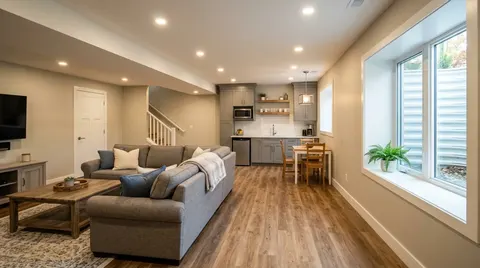
For a typical North Vancouver basement being finished as family space, our default spec is SPC vinyl plank with a 20 mil wear layer over a ground and levelled slab, with porcelain tile in the bathroom and around the mechanical area. It handles the climate, it survives a leak, it's warm enough underfoot without added heat, and it looks good.
For a basement suite that will be rented, same answer, and we go up to a 22 mil wear layer. Tenant traffic is harder on a floor than family traffic, and the extra $1.50 per square foot buys years.
For a high-end media room or a walkout that functions as main living space, tile with in-floor heat is worth the money. That's the one case where the comfort difference justifies doubling the flooring budget.
Frequently asked questions
What is the best flooring for a basement in Vancouver?
Rigid-core SPC vinyl plank is the best all-round basement flooring for the Vancouver area. It is waterproof, does not swell, survives a plumbing leak, and costs $8 to $14 per square foot installed. Porcelain tile with an uncoupling membrane performs even better but costs $14 to $28 per square foot and is cold underfoot without in-floor heating.
Can you install hardwood in a basement in BC?
Solid hardwood should not be installed below grade in BC. Engineered hardwood is possible but risky: it requires a slab moisture test, a sheet or epoxy vapour barrier, a plywood-core product, and a floating installation, bringing the cost to $12 to $22 per square foot. Even done correctly it will not survive a plumbing failure the way vinyl or tile will.
Do I need a subfloor under basement flooring?
Not always. Rigid vinyl and tile install directly over a prepared slab. A dimpled subfloor panel system adds warmth and an air gap over the slab for $3 to $5 per square foot, but it consumes about three quarters of an inch of ceiling height, which matters in older North Shore basements already close to the 6 foot 11 inch code minimum.
Why does basement flooring fail in Vancouver homes?
Almost always because of slab moisture rather than the flooring material. Concrete slabs continuously pass moisture vapour up from the soil, and most Lower Mainland homes built before the mid-1980s have no under-slab vapour barrier. Skipping a slab moisture test, a vapour retarder, or slab levelling is what causes seam failure, cupping, and cracked grout.
How much does vinyl plank flooring cost for an 800 square foot basement in North Vancouver?
Rigid-core SPC vinyl plank runs $4 to $9 per square foot supplied plus $3 to $5 per square foot to install over a prepared slab, so an 800 square foot basement comes in at $5,600 to $11,200 all in. If a supply line fails later, you pull the planks, dry the slab, and put the same planks back down.
What wear layer should basement vinyl plank have for a family space or a rental suite?
Anything under a 12 mil wear layer will show traffic patterns within five years in a family space. Our default spec for a North Vancouver family basement is a 20 mil wear layer, and for a rented basement suite we go up to 22 mil, because tenant traffic is harder on a floor than family traffic and the extra $1.50 or so per square foot buys years.
What slab moisture reading rules out glued or wood flooring in a basement?
Anything over about 75% relative humidity in the slab, measured with a calcium chloride test or an RH probe, is a problem for glued flooring and any organic material. Most North Shore basements we test come in between 75 and 90% unless there is a functioning vapour barrier under the slab, and homes built before the mid-1980s frequently have no under-slab barrier at all.
Is in-floor heating worth it under basement tile in Deep Cove or Lynn Valley?
Tile is cold, and in a Deep Cove or Lynn Valley basement with a north-facing exposure that is a real comfort issue. Electric in-floor heating mats add $12 to $20 per square foot installed, which puts the whole floor assembly at $30 to $45 per square foot. That is worth the money for a high-end media room or a walkout that functions as main living space, and hard to justify elsewhere.
Why do grout lines crack in a straight line across older basement floors?
Because the tile was bonded to the slab without an uncoupling membrane. Concrete slabs move seasonally with moisture and temperature, and a membrane like Ditra decouples the tile from that movement. Skipping the membrane is the specific reason you see cracked grout lines running straight across older basement floors.
What slab preparation has to happen before basement flooring goes down?
Sort out perimeter drainage and grading first if there is any history of moisture, then test the slab and write the number down. Grind or self-level any variation over 3 mm across a 3 metre span, seal cracks with a flexible epoxy, confirm the slab is clean of old adhesive and paint, and leave the flooring in the room for at least 48 hours before installation. Every failed basement floor we have been called in to replace failed because someone skipped this prep, not because of the finish material.
What happened to the engineered hardwood basement floors RealDream has replaced?
We have replaced two engineered hardwood floors in North Vancouver basements in the past three years, both installed by other companies. Both failed at the seams within four years, and neither had a moisture barrier under it. Engineered wood below grade runs $12 to $22 per square foot installed with proper moisture mitigation, which is tile money for a material that performs worse.
Is broadloom carpet ever a good choice on a Vancouver basement slab?
No. Broadloom directly on a basement slab is the one option we actively argue against: the backing and pad are organic enough to support mould, they hold water for days, and a wet basement carpet is a remediation job, not a cleaning job. Carpet tile with a closed-cell backing is the workable alternative at $6 to $12 per square foot installed, because individual tiles can be lifted to dry.
Related service
Basement Renovation
See how we handle basement renovation projects across the North Shore.
Learn about basement renovationRelated articles