


The short answer
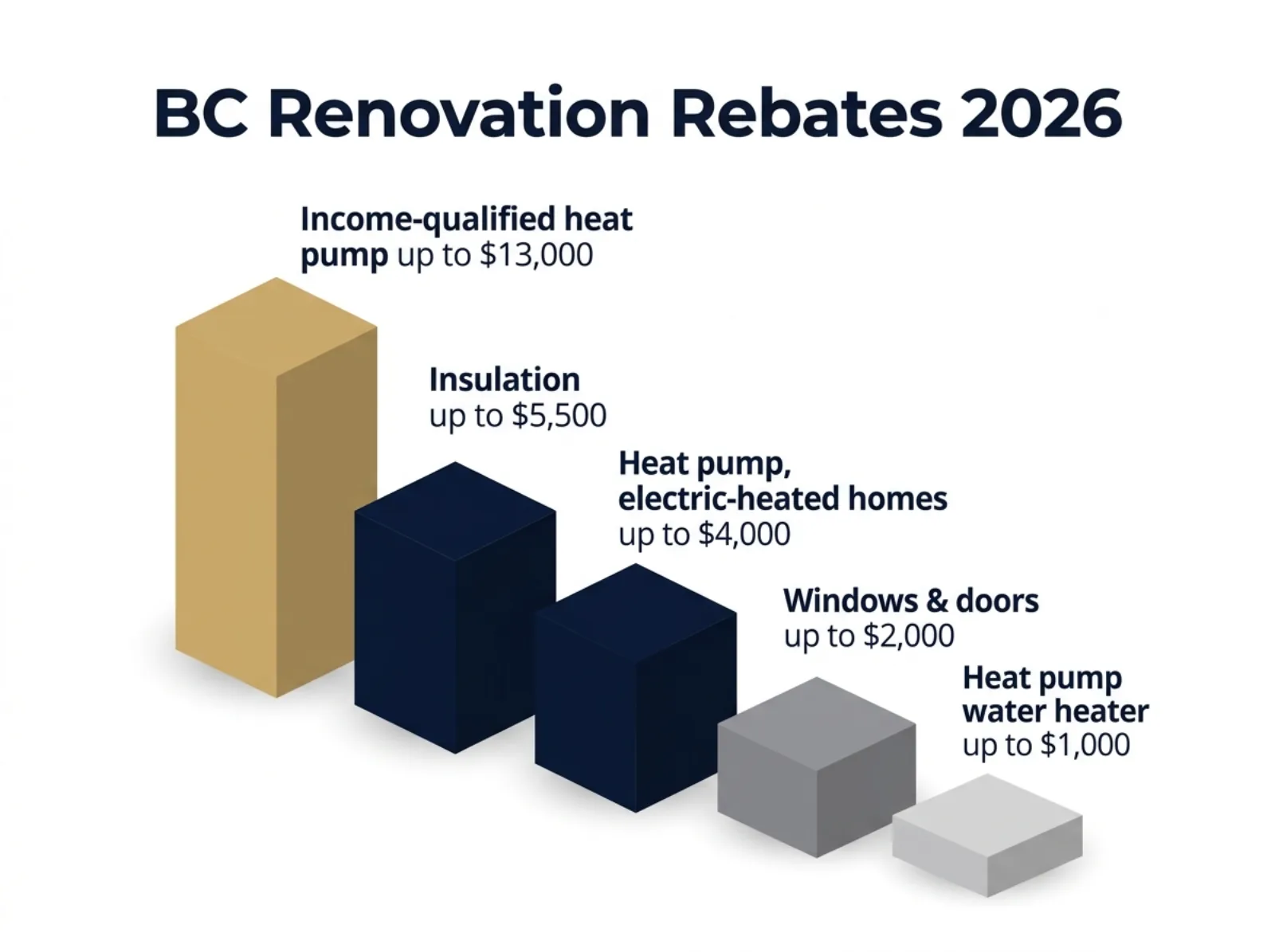
As of August 2026, two programs at betterhomesbc.ca are open: the any-income Home Renovation Rebate, paying up to $5,500 for insulation, $2,000 for windows and doors, and $4,000 for a heat pump in an electrically heated home, and the income-qualified CleanBC Energy Savings Program, paying up to $13,000 toward a gas-to-heat-pump conversion. The federal Greener Homes Grant and FortisBC's dual fuel rebate have both closed.
The 2026 map: two programs, one website
BC's residential energy rebates now run through two programs, both administered through betterhomesbc.ca. The Home Renovation Rebate is the any-income stream, funded by BC Hydro and FortisBC together with the Province. The CleanBC Energy Savings Program is the income-qualified stream, and it is where the large money now lives for households that qualify.
Everything else you may have read about is either closed or folded into those two. That single fact simplifies the research for a North Vancouver or West Vancouver homeowner enormously: one website, two programs, and the question of which stream your household fits into. The complication is in the eligibility details, which is where the rest of this article goes.
The Home Renovation Rebate: open to any income
The Home Renovation Rebate covers the envelope upgrades most renovations touch anyway. Insulation earns up to $5,500. Windows and doors earn up to $2,000. A heat pump water heater replacing an electric tank earns up to $1,000. Those apply at any income level with a BC Hydro or FortisBC account, which covers essentially every North Shore home.
Heat pumps are where the fine print matters. Outside northern BC, the Home Renovation Rebate pays heat pump rebates only on homes currently heated by electricity: up to $4,000 for a whole-home system, or $1,500 for a partial-home system covering at least half the heating load. If your North Vancouver home heats with baseboards, you qualify. If it heats with a gas furnace, this stream pays you nothing toward a heat pump, and that surprise catches more people than any other detail in the current programs.
The bonuses stack meaningfully. A two-upgrade bonus pays up to $2,000 for completing multiple eligible upgrades together. A home energy improvement bonus pays $750 to $2,000 when you complete three or more eligible upgrades with pre and post EnerGuide evaluations. And BC Hydro is running a limited-time bonus of up to $1,000 on air-source heat pump installs completed by October 31, 2026, first come, first served. BC Hydro states a cap of $12,500 across all upgrades on an electricity-heated home, which is a genuinely useful number on a whole-home energy retrofit.
The Energy Savings Program: bigger money, income-tested
The CleanBC Energy Savings Program is the income-qualified stream, and for households that fit, it is dramatically more generous. A Level 1 income household, which reaches up to $94,900 of combined pre-tax income for a family of four, converting a gas-heated, ground-oriented home to a central ducted heat pump can receive up to $13,000. Level 2 households receive up to $7,000 for the same conversion, and Level 3, which extends up to $189,800 of household income for a family of four, receives up to $3,500.
The program also pays up to $5,000 toward an electrical service upgrade done as part of a heat pump switch at Level 1, with $3,500 at Level 2 and $1,500 at Level 3. That matters on the North Shore, where most pre-1990 homes still run 100-amp service and a 200-amp upgrade costs $3,000 to $5,000 in the straightforward case. A heat pump water heater earns $3,500 at all qualifying levels, and ventilation earns $1,600 at Levels 1 and 2.
Two changes landed on July 6, 2026 that anyone applying this year should know about: rebate amounts were reduced from their earlier levels, and eligibility codes now expire three months after approval. That second one has teeth. Approval is no longer something you can bank and act on next season. Once your code is issued, the clock to installation is running, so line up your contractor before you apply, not after.
What closed, because people still budget around it
This list is the reason we wrote the article. The federal Canada Greener Homes Grant is closed to new applicants, and the Canada Greener Homes Loan closed on October 1, 2025. Files started before those dates are still being processed, but no new ones are accepted. The federal program still active is the Canada Greener Homes Affordability Program, which serves low-to-median-income households through a directed retrofit process rather than an open application.
FortisBC's dual fuel rebate, which paid $5,000 and up on a heat pump paired with a gas furnace, took its final applications on December 18, 2025, and the program page now lists it as unavailable. And the municipal top-ups that both North Vancouver municipalities ran through Better Homes BC, such as the District of North Vancouver's $350 heat pump water heater top-up, no longer appear on the program site as of August 2026. Treat any mention of North Shore municipal top-ups as history unless your municipality confirms otherwise when you call.
The gas-conversion gap nobody advertises
Put the two streams side by side and a hole appears. A gas-heated North Vancouver household above the Energy Savings Program income thresholds currently has no significant rebate toward a full heat pump conversion. The any-income stream only covers electrically heated homes outside northern BC, the income-qualified stream has its thresholds, the dual fuel rebate is gone, and the federal grant is gone.
We say this plainly because it changes decisions. A gas-to-heat-pump conversion for a household in that gap stands on its own economics: operating costs roughly 40 to 60 percent below a gas furnace per unit of heat, cooling the house did not have before, and the direction the Zero Carbon Step Code is already pushing new construction. Those are real arguments, and for many owners they carry the project. But in August 2026 the rebate cheque is not part of that math, and a contractor who tells you otherwise is working from an old brochure. If the gap closes, it will close on betterhomesbc.ca first.
The conditions that quietly void a rebate
Most rebate money that gets lost is lost to sequencing, not eligibility. These are the conditions in the current programs that cannot be fixed after the fact.
- Book the pre-upgrade EnerGuide evaluation before demolition or equipment installation. The home energy improvement bonus of $750 to $2,000 requires pre and post evaluations, and there is no way to create the baseline once walls are open. The pre and post visits together run about $600
- Use a Home Performance Contractor Network member where the program requires one. Heat pump rebates can be denied on the installer alone, even when the equipment qualifies
- Submit the application within six months of the invoice date for Home Renovation Rebate claims
- Install within three months of approval under the Energy Savings Program, because eligibility codes now expire
- Whole-home heat pump rebates on homes over 1,200 square feet require a central ducted or multi-split system, and the unit must meet 100 percent of the heating load at minus 5 Celsius. A single ductless head in the living room is rebated as partial-home at $1,500, not $4,000
Rebates against real 2026 costs
It helps to see the rebate numbers next to what the upgrades actually cost on the North Shore, because the proportions vary wildly. An attic insulation top-up runs $2,000 to $4,000 on a typical home, so the insulation rebate of up to $5,500 can cover a large share of that job, and insulation plus air sealing is already the best-value energy work on a pre-1980 house. An air sealing package runs $2,500 to $7,000.
At the other end, whole-house window replacement runs $18,000 to $35,000 for a 20-window home, against a $2,000 maximum rebate. A ducted heat pump runs $12,000 to $30,000 installed depending on ductwork condition and scope, against $4,000 in the any-income stream if you're switching from electric, or up to $13,000 in the income-qualified stream for a gas conversion. A heat pump water heater runs $3,500 to $8,000 installed against $1,000 or $3,500 depending on your stream.
The honest planning conclusion: rebates should tune your scope, not drive it. They meaningfully improve the math on insulation, air sealing, and income-qualified conversions, and they are a modest discount on everything else. A renovation designed around chasing rebate maximums is designed backwards. Do the work the house needs, then claim everything that work qualifies for.
The sequence we run on rebate-eligible projects
On any North Shore renovation with rebate-eligible scope, the order of operations is fixed before demolition is scheduled. First, confirm which stream the household fits, because the income-qualified thresholds reach further up than most people assume: $189,800 for a family of four at Level 3 covers a lot of North Vancouver households. Second, book the EnerGuide baseline. Third, confirm the installer qualifies under the program's contractor network where required. Fourth, for Energy Savings Program work, apply only when the installation can happen inside the three-month code window.
The application itself is generally the homeowner's to submit, and that hasn't changed. What a good contractor does is tell you which items in the scope qualify, provide invoices in the format the program wants, and sequence the project so no condition is missed. That costs nothing extra. It just requires knowing the current rules rather than the 2023 rules, which, as this article hopefully shows, are not the same thing.
Sources
Frequently asked questions
What renovation rebates are actually open to BC homeowners in 2026?
Two programs, both through betterhomesbc.ca. The Home Renovation Rebate, open at any income, pays up to $5,500 for insulation, up to $2,000 for windows and doors, up to $4,000 for a whole-home heat pump in an electrically heated house, and up to $1,000 for a heat pump water heater, with a stated cap of $12,500. The income-qualified CleanBC Energy Savings Program pays up to $13,000 on a gas-to-heat-pump conversion plus up to $5,000 toward an electrical service upgrade.
Is there still a rebate for replacing a gas furnace with a heat pump in BC?
Only for income-qualified households as of August 2026. The Energy Savings Program pays up to $13,000 at income Level 1, $7,000 at Level 2, and $3,500 at Level 3 for a central ducted conversion in a ground-oriented home. FortisBC's dual fuel rebate took final applications December 18, 2025, and outside northern BC the any-income Home Renovation Rebate covers heat pumps only in homes already heated by electricity, so a gas-heated household above the thresholds currently gets no significant rebate.
Is the Canada Greener Homes Grant still available in 2026?
No. The federal Greener Homes Grant is closed to new applicants, and the Greener Homes Loan closed on October 1, 2025, with only pre-deadline files still processing. The remaining active federal program is the Canada Greener Homes Affordability Program, which serves low-to-median-income households through a directed retrofit process rather than an open application.
What income counts as income-qualified for the CleanBC Energy Savings Program?
The thresholds reach higher than most people assume. Level 1 extends up to $94,900 of combined pre-tax household income for a family of four, and Level 3 reaches up to $189,800 for a family of four, which covers a lot of North Vancouver households. Rebate size steps down by level: a gas-to-heat-pump conversion pays up to $13,000, $7,000, or $3,500 at Levels 1, 2, and 3 respectively.
What changed in the Energy Savings Program on July 6, 2026?
Two things: rebate amounts were reduced from their earlier levels, and eligibility codes now expire three months after approval. The expiry rule means approval can no longer be banked for next season. Line up your contractor before applying, because once the code is issued the clock to installation is running.
Why did my neighbour get a heat pump rebate and my gas-heated house can't?
Because outside northern BC, the any-income Home Renovation Rebate pays heat pump rebates only on homes currently heated by electricity: up to $4,000 whole-home or $1,500 partial. A baseboard-heated house qualifies; a gas-furnace house does not, unless the household fits the income-qualified Energy Savings Program thresholds. This is the single most misunderstood rule in the current BC programs.
Are there still North Vancouver municipal top-ups on energy rebates?
Not as of August 2026. The municipal top-ups both North Vancouver municipalities ran through Better Homes BC, such as the District of North Vancouver's $350 heat pump water heater top-up, no longer appear on the program site. Treat any mention of North Shore municipal top-ups as history unless the municipality confirms a current offer when you call.
What is the BC Hydro heat pump bonus deadline in 2026?
October 31, 2026. BC Hydro is running a limited-time bonus of up to $1,000 on eligible air-source heat pump installations completed by that date, first come, first served, on top of the standard Home Renovation Rebate amounts. Completed means installed, not approved, so the booking lead time for installers counts against the deadline.
Do I need an EnerGuide evaluation to claim BC rebates in 2026?
For some rebates, yes, and the safe move is booking it before any work starts. The home energy improvement bonus of $750 to $2,000 requires pre and post EnerGuide evaluations plus three or more eligible upgrades, and the baseline cannot be created after walls are open or equipment is installed. The pre and post visits together cost about $600.
Can any contractor's installation qualify for BC heat pump rebates?
No. Heat pump rebates require installation by a Home Performance Contractor Network member, and a rebate can be denied on the installer alone even when the equipment qualifies. Applications also have to land within six months of the invoice for Home Renovation Rebate claims. Confirm both conditions before hiring, not after.
Does a single ductless head qualify for the whole-home heat pump rebate?
Not in most houses. BC Hydro's whole-home rebate requires homes over 1,200 square feet to use a central ducted or multi-split system meeting 100 percent of the heating load at minus 5 Celsius. A single head in the living room of a larger home is rebated as a partial-home system at $1,500 rather than the $4,000 whole-home amount.
How much of a real renovation cost do the 2026 rebates cover?
It varies by upgrade. An attic insulation top-up at $2,000 to $4,000 can be substantially covered by the insulation rebate of up to $5,500, while whole-house window replacement at $18,000 to $35,000 earns at most $2,000. A ducted heat pump at $12,000 to $30,000 earns $4,000 in the any-income stream or up to $13,000 income-qualified. Rebates should tune the scope, not drive it.
Related service
Home Renovation
See how we handle home renovation projects across the North Shore.
Learn about home renovationRelated articles