
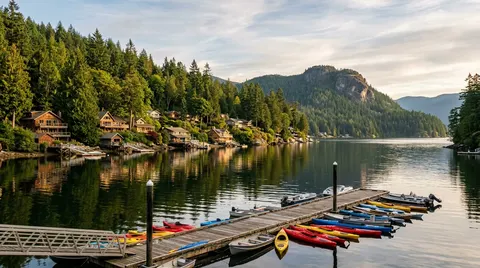
One shore, three municipalities
First, the geography, because it trips people up constantly. The North Shore is three separate municipalities: the City of North Vancouver, the District of North Vancouver, and the District of West Vancouver, which covers everything west of the Capilano River from Ambleside to Horseshoe Bay. Each runs its own building department with its own bylaws and fee schedules. We have written a separate comparison of the City and District of North Vancouver; this guide is about the third and most demanding of the three.
West Vancouver's reputation among builders is earned but often misunderstood. The department is thorough rather than slow for its own sake. The terrain and the housing stock genuinely carry more risk, steep slopes, rock, creeks, mature trees, waterfront exposure, and the bylaw structure reflects that. Understand what applies to your property before designing anything and the process is manageable. Discover it at the permit counter and you will lose months.
What triggers a building permit
The baseline follows the BC Building Code: new construction, additions, and alterations to an existing building need a permit. In renovation terms, that means structural changes, moving interior walls, and relocating or altering plumbing, gas, or electrical systems all trigger one. Purely cosmetic work, paint, flooring, cabinet swaps, and trim that touches no structure or services, does not.
Two West Vancouver specifics to respect. First, the District requires permits for some work that other municipalities treat as minor, so never assume a scope is exempt here because it was exempt somewhere else. Second, some projects need a development permit before the building permit can even be submitted, particularly where a property sits in one of the District's natural hazard or environmental development permit areas. That sequencing matters: the development-level approvals come first, and they can take longer than the building permit itself.
Separate permits also exist for plumbing, electrical, and mechanical work. The electrical side is the fast lane: the District processes online electrical permit applications in about one to two business days.
Fees: where they are set and how they work
West Vancouver's permit fees are set in its Fees and Charges Bylaw No. 5383, 2025, with the current rates effective January 1, 2026. Building permit fees scale with the value of construction, so a $150,000 kitchen renovation and a $1.5 million whole-home project pay very different amounts. The District does not publish a simple flat-rate table for renovations, and the bylaw covers dozens of related charges, tree permits, blasting permits, development applications, so budget from the bylaw schedule for your specific scope rather than from a rule of thumb.
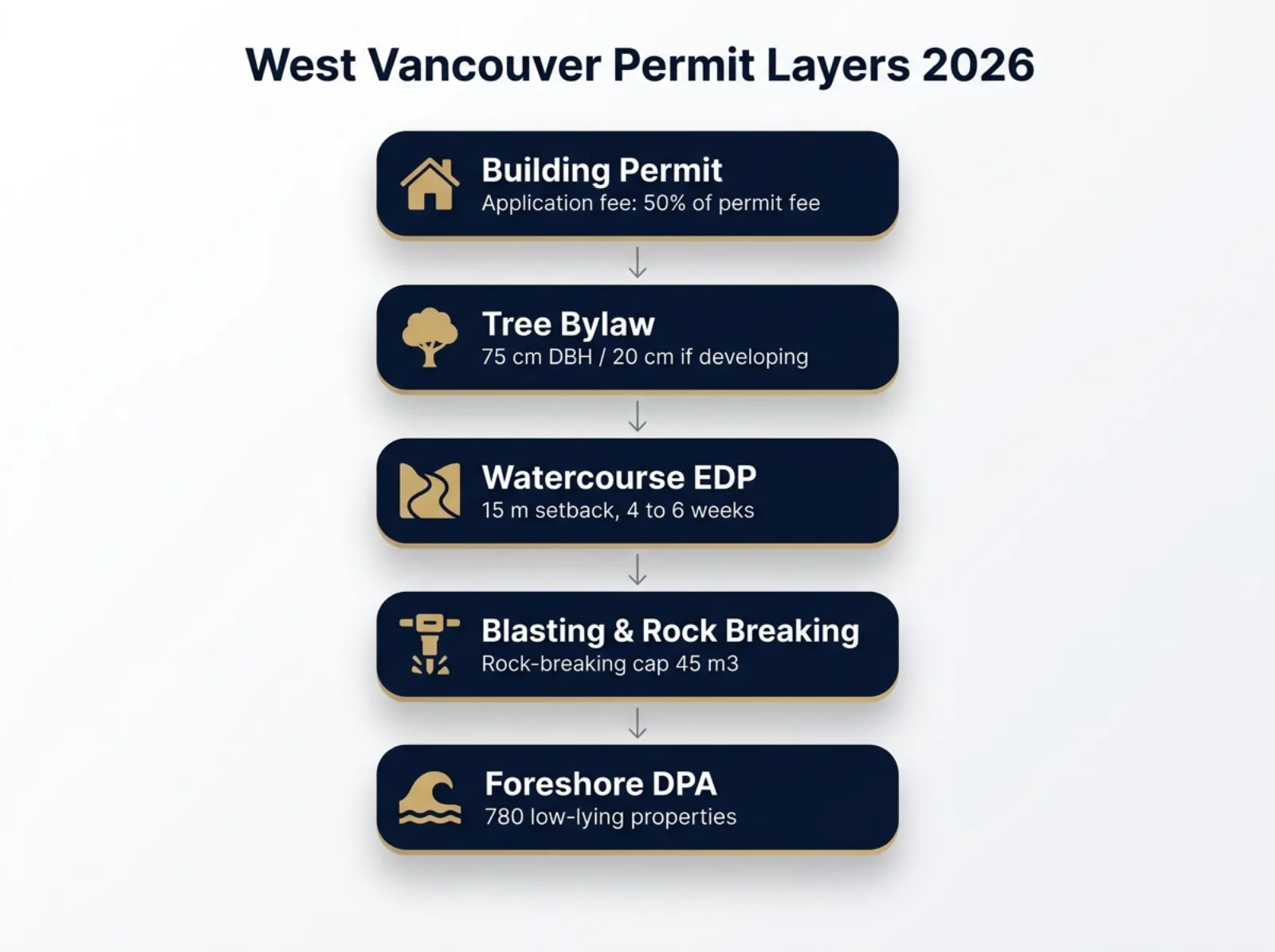
One number worth knowing upfront: the application fee is 50 percent of the permit fee, payable when you apply, and it is not refundable. On a large project that is real money committed before approval, which is one more reason to submit a complete, correct package the first time. The permits department at 604-925-7040 will confirm the fees that apply to a given scope before you commit.
Processing times: what is published and what we see
The District does not publish a running queue time for building permits, so treat any specific number you read online with caution. What it does publish: environmental development permits typically process in four to six weeks when the submission is complete, and online electrical permits clear in one to two business days.
From our own projects, labelled as experience rather than policy: straightforward interior renovation permits move reasonably, on the order of weeks. Anything touching the building envelope, the footprint, or a slope runs months. Complex projects with multiple overlapping approvals have waited a year, and new custom homes routinely exceed twelve months. The single most common cause of delay is not the department, it is an incomplete application, a missing geotechnical report, arborist report, or drainage design that stops the clock until it arrives.
The tree bylaw, tightened in December 2025
West Vancouver adopted its Tree Bylaw in November 2020, replacing the 2016 interim version, and amended it again with effect from December 15, 2025. The current structure has two tiers. On most properties, trees of 75 centimetres diameter or more, measured at 1.3 metres above ground, are protected. But on a parcel being developed with a new residential or commercial building, or being subdivided, the protected threshold drops to 20 centimetres, which captures most of the mature trees on a typical lot.
Two further layers apply everywhere: Pacific yew, Pacific dogwood, yellow cedar, and shore pine are protected at 20 centimetres regardless of the property's status, and any tree over 10 centimetres within 15 metres of the top of bank of a watercourse is protected. Removing a protected tree requires a permit, an arborist's rationale that meets the bylaw's removal criteria, and replacement planting requirements.
For renovations, the practical test is the footprint. Interior work rarely engages the bylaw. Additions, driveways, and site regrading near mature trees mean an arborist report, protection fencing, and sometimes a redesign around root zones. Get the arborist involved at design stage, not application stage.
Creeks and the watercourse rules
Dozens of creeks run off the mountains through West Vancouver to the sea, and many private lots have one crossing or bordering them. The District's Watercourse Protection Bylaw No. 4364 dates from 2005 and requires erosion and sediment control on construction projects, but the bigger constraint is the environmental development permit: in existing neighbourhoods, any proposed development within 15 metres of the top of bank of a watercourse requires an EDP before work can proceed. In the Upper Lands, above Highway 1 in future development areas, the protected setback extends to 30 metres.
Behind the municipal layer sits the provincial one. BC's Riparian Areas Protection Regulation defines a riparian assessment area of 30 metres on each side of a stream, and development within it requires an assessment by a qualified environmental professional before a local government can approve the application. If your renovation expands toward a creek, that QEP report joins the submission package, and the four-to-six-week EDP timeline starts only once the reports are complete and accurate.
Rock removal: blasting is its own permit
Much of West Vancouver sits on rock, and the District regulates its removal under the Revised Soil Removal, Deposit, Blasting and Rock Breaking Bylaw No. 5130, adopted in 2021. The structure is strict. Blasting permits cover removal with explosives, the standard method for large volumes. Rock-breaking permits cover drilling, splitting, or percussive breaking, capped at 45 cubic metres. Volumes under 10 cubic metres qualify for a shortened small-volume process. And rock hammering is not a permitted removal method in the District at any time, which surprises contractors arriving from municipalities where a hoe ram is routine.
Sequencing is the trap: a building permit must be issued and in good standing before the District will accept a blasting or rock-breaking application. So if your basement or pool scope involves rock, the rock permit adds its own step after the building permit, complete with pre-blast surveys of neighbouring structures and licensed blasting contractors. Price and schedule it from day one.
The foreshore: rules along the waterline
In April 2022 the District adopted a Foreshore Development Permit Area covering roughly 780 low-lying properties between Ambleside and Horseshoe Bay. It exists for two reasons: coastal flood risk as sea levels rise, and protection of the intertidal habitat. Redevelopment within the area follows the District's foreshore protection guidelines, including the requirement to build habitable space up to the flood construction level, and tree removal within the foreshore protection area has its own permit stream.
If you own waterfront or near-waterfront property, this layer applies on top of everything above, and it reaches further uphill than most owners expect, because it captures upland properties below the flood construction level, not just lots that touch the water. We cover the full waterfront picture, salt, wind, and access included, in a separate guide.
How West Vancouver compares to the North Vancouvers
In the City of North Vancouver, minor alterations can clear in 4 to 6 weeks and a straightforward renovation permit in 6 to 10 weeks, helped by flat lots and simpler projects. The District of North Vancouver runs longer, 5 to 8 months for new home permits and more where variances are involved, largely because of slope, trees, and drainage review. West Vancouver is the longest and most demanding of the three: similar terrain challenges to the District of North Vancouver, plus the foreshore layer, the strictest rock rules, and higher design expectations in certain areas.
The comparison matters if you are choosing between properties. The same renovation concept can carry a materially different approval timeline and soft-cost budget depending on which side of the Capilano River the lot sits. None of the three is unworkable. They are just different queues with different paperwork, and the budget should reflect the actual municipality rather than a North Shore average.
Getting through it: what actually works
Submit complete or do not submit. Geotechnical report where slopes are involved, $3,000 to $5,000. Arborist report where protected trees stand near the work. Drainage design, retaining wall engineering, QEP assessment where a creek is in range. An incomplete package is the most common reason a West Vancouver application sits, and each missing report restarts a review cycle.
Run the clock in parallel. We carry design development, engineering, and trade tendering forward while the permit is in review rather than after it, which routinely saves two to three months. And build the carrying cost of the review period into the project budget honestly: on a large West Vancouver renovation, the approval phase is not dead time, it is part of the project, and pretending otherwise is how schedules and budgets get broken before demolition starts.
Frequently asked questions
What renovation work needs a building permit in West Vancouver?
Structural changes, moving interior walls, and relocating or altering plumbing, gas, or electrical systems all require a building permit in the District of West Vancouver, following the BC Building Code baseline. Cosmetic work like paint, flooring, and cabinet swaps does not. The District also requires permits for some work other municipalities treat as minor, so confirm your specific scope with the District rather than assuming an exemption carries over.
How much are building permit fees in West Vancouver in 2026?
Fees are set in the District's Fees and Charges Bylaw No. 5383, 2025, with rates effective January 1, 2026, and they scale with the value of construction rather than following a flat table. The application fee is 50 percent of the permit fee, payable on application and non-refundable. The District's permits department at 604-925-7040 will confirm the fees for a specific scope.
How long does a building permit take in West Vancouver in 2026?
The District does not publish a running queue time for building permits. It does publish that environmental development permits typically process in four to six weeks and online electrical permits in one to two business days. In our project experience, interior renovation permits move in weeks, envelope or structural scope runs months, complex multi-approval projects have waited a year, and new custom homes routinely exceed twelve months.
What size tree is protected in West Vancouver in 2026?
On most properties, trees of 75 centimetres diameter or more at 1.3 metres above ground are protected. Since the amendment effective December 15, 2025, the threshold drops to 20 centimetres on parcels being developed with a new residential or commercial building or being subdivided. Pacific yew, Pacific dogwood, yellow cedar, and shore pine are protected at 20 centimetres everywhere, and trees over 10 centimetres within 15 metres of a watercourse's top of bank are also protected.
Do I need an environmental development permit for a creek on my West Vancouver property?
Yes, if the proposed development sits within 15 metres of the top of bank of a watercourse in an existing neighbourhood. In the Upper Lands above Highway 1, the protected setback extends to 30 metres. The District publishes a typical processing time of four to six weeks for a complete environmental development permit application, and BC's Riparian Areas Protection Regulation can also require an assessment by a qualified environmental professional before approval.
Can I use a rock hammer for excavation in West Vancouver?
No. Rock hammering is not a permitted rock removal method anywhere in the District of West Vancouver at any time. Rock removal requires either a blasting permit for explosives or a rock-breaking permit for drilling, splitting, or percussive breaking, which is capped at 45 cubic metres, with a shortened process for volumes under 10 cubic metres, all under the District's Bylaw No. 5130.
Does a blasting permit come before or after the building permit in West Vancouver?
After. A building permit must be issued and in good standing before the District of West Vancouver will accept a blasting or rock-breaking permit application. That sequencing means rock removal adds its own permit step, plus pre-blast surveys of neighbouring structures and a licensed blasting contractor, after the main approval, so it belongs in the schedule from the start.
What is the West Vancouver Foreshore Development Permit Area?
It is a development permit area the District adopted in April 2022 covering roughly 780 low-lying properties between Ambleside and Horseshoe Bay, created for coastal flood risk and intertidal habitat protection. Redevelopment within it follows the District's foreshore protection guidelines, including building habitable space up to the flood construction level, and it captures upland properties below that level, not just lots touching the water.
How do West Vancouver permit timelines compare to North Vancouver?
West Vancouver runs the longest and most layered process of the three North Shore municipalities. By comparison, minor alterations in the City of North Vancouver can clear in 4 to 6 weeks and straightforward renovation permits in 6 to 10 weeks, while District of North Vancouver new home permits run 5 to 8 months. West Vancouver adds foreshore rules, the strictest rock removal regime, and added design scrutiny in certain areas on top of terrain review similar to the District of North Vancouver's.
Why do West Vancouver permit applications get delayed?
The most common cause is an incomplete package, not the department itself. Missing geotechnical reports ($3,000 to $5,000 where slopes are involved), arborist reports, drainage designs, retaining wall engineering, or QEP assessments each stop the clock until they arrive and restart a review cycle. Submitting complete the first time, and running design and tendering in parallel with the review, routinely saves two to three months.
Do electrical permits take as long as building permits in West Vancouver?
No. The District processes online electrical permit applications in about one to two business days, which makes them the fastest permit stream it runs. Building permits are the slow lane by comparison, with interior renovation scopes taking weeks and envelope or structural scopes taking months in our experience.
Is the West Vancouver permit application fee refundable?
No. The application fee is 50 percent of the building permit fee, payable when you apply, and the District states it is not refundable. On a large renovation that is a real sum committed before approval, which is a strong argument for getting the design, reports, and drawings right before submitting rather than treating the first application as a draft.
Related service
Project Management in West Vancouver
See how we handle project management in west vancouver projects across the North Shore.
Learn about project management in west vancouver