


The short answer
A home's heritage status decides what can change. A Community Heritage Register listing carries few legal restrictions, but a Heritage Designation or Heritage Revitalization Agreement needs municipal heritage planner approval for changes to protected exterior elements, like the porch, roofline, or windows. Interiors and rear additions are usually free to renovate. Expect a 25 to 45 percent cost premium over a conventional North Vancouver renovation, and budget 20 percent contingency.
Heritage designations in North Vancouver: what they actually mean
There are two levels of heritage protection on the North Shore. A home on the Community Heritage Register is recognized as having heritage value, but there are limited legal restrictions on what you can do to it. The municipality wants to be consulted, and they may push back on demolition, but you can generally renovate. A home with a Heritage Designation or Heritage Revitalization Agreement (HRA) is a different story. Those have legal protections, and changes to designated elements need approval from the municipality's heritage planner.
The City of North Vancouver has a more active heritage program than the District. The City maintains a heritage register with about 200 properties, and they offer Heritage Revitalization Agreements that trade density bonuses (like allowing a secondary suite or laneway house) in exchange for formal heritage designation and restoration commitments. The District has a register too, but it's smaller and the incentive programs are less developed.
If you're buying a pre-1950 home and planning a renovation, check the heritage register before you close. It's public information: both municipalities publish their lists. A heritage-registered home isn't a problem, but it changes the renovation approach, the permit process, and sometimes the budget.
What's protected and what can change
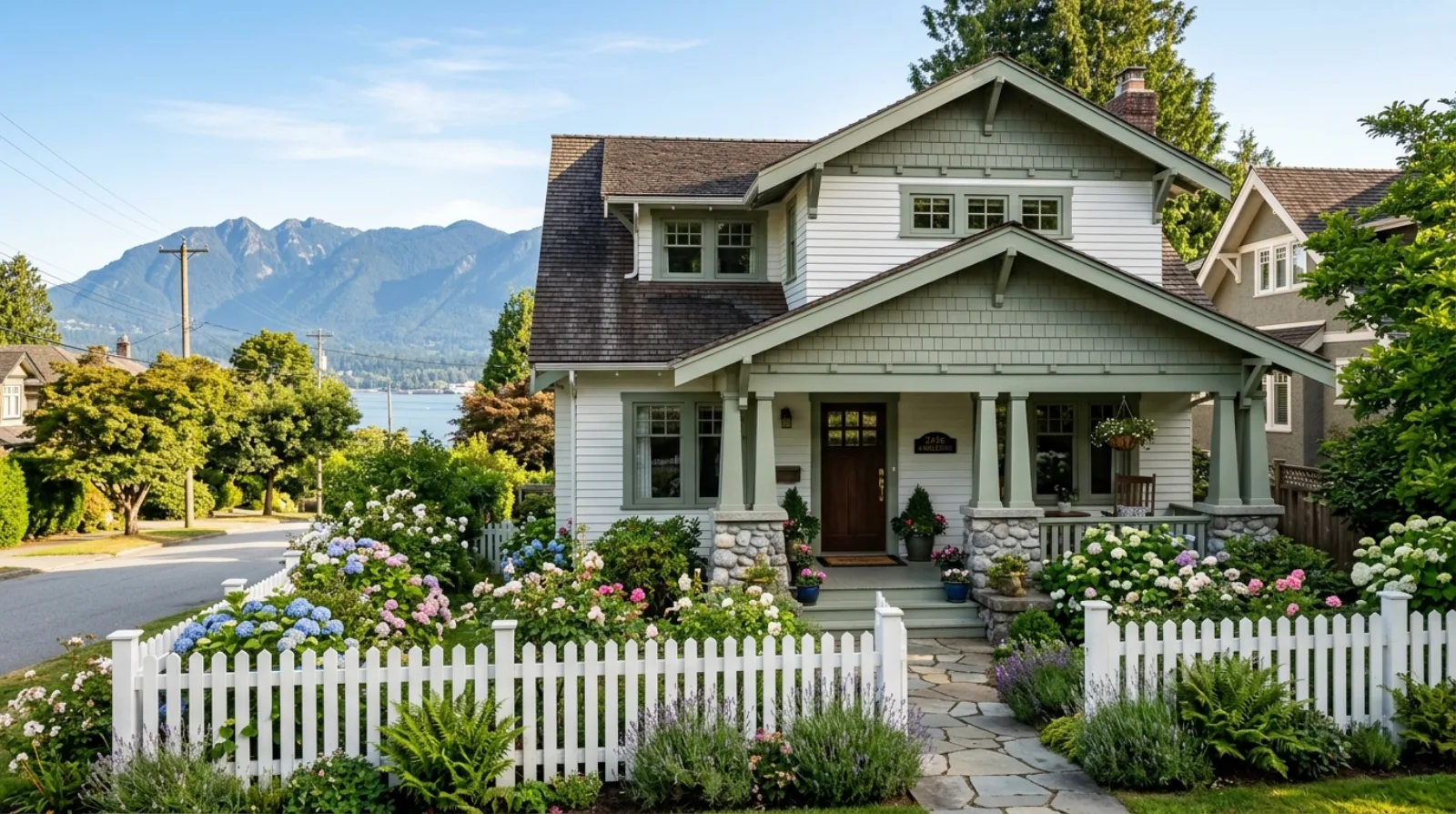
Heritage protection typically applies to the character-defining elements of the home. The features that make it recognizably historic. For a Craftsman bungalow, that might be the front porch, the roof profile, the window proportions, and the exterior cladding. For a wartime house, it might be the overall massing and the street-facing facade.
What's usually not protected: the interior, the rear of the building, mechanical systems, and anything that's been already altered beyond recognition. You can typically gut the inside of a heritage home completely, rewire it, replumb it, insulate it, and modernize every system: as long as the exterior character elements are preserved or restored.
Rear additions are generally allowed on heritage homes, provided they're set back from the front facade and designed to be visually subordinate to the original structure. This is actually one of the most common heritage renovation strategies on the North Shore: keep the front, add to the back. You preserve the streetscape character and get the modern floor plan and systems you need.
Typical conditions in pre-1950 North Shore homes
If you've never opened up the walls of a 1930s or 1940s North Vancouver home, here's what to expect. The framing is usually full-dimension lumber: real 2x4s that are actually 2 inches by 4 inches, not the 1.5 by 3.5 of modern lumber. That's good; it's stronger. But the sheathing is often ship-lap boards rather than plywood, and there's no house wrap or vapour barrier. Insulation ranges from nothing to wood shavings to early mineral wool batts.
Electrical systems in pre-1950 homes are almost always knob-and-tube wiring, sometimes partially updated with Romex in later decades. Knob-and-tube isn't inherently dangerous if it's in good condition and hasn't been buried in insulation, but it can't be insulated over (fire risk) and most insurance companies won't cover homes with active knob-and-tube. Plan on a full rewire: $15,000-$30,000 for a typical home, depending on size and access.
Plumbing in pre-1950 homes is galvanized steel supply pipes and cast iron drains. Galvanized pipes corrode from the inside out, reducing flow over decades. If you cut into a galvanized pipe and see a pinhole-sized opening where there should be a 3/4-inch bore, that pipe is done. Budget $10,000-$20,000 for a full replumb with copper or PEX supply lines and ABS drain lines.
- Full electrical rewire (knob-and-tube to modern): $15,000-$30,000
- Full replumb (galvanized/cast iron to copper/PEX/ABS): $10,000-$20,000
- Asbestos abatement (if present in insulation, floor tiles, or pipe wrap): $5,000-$15,000
- Lead paint remediation: $3,000-$10,000 depending on scope
- Foundation repair or replacement: $30,000-$80,000+
Foundation issues: the expensive surprise
Pre-1950 foundations on the North Shore are typically unreinforced concrete or, in the oldest homes, rubble stone. After 80-plus years in North Vancouver's wet climate, many of these foundations are showing their age. Cracks, spalling, water infiltration, and settling are common. And because North Van soil conditions vary dramatically (you might have well-draining gravel in Norgate and heavy clay in Capilano Highlands two kilometres away) foundation conditions are unpredictable until you get a structural engineer involved.
If the foundation is sound but needs waterproofing, expect $15,000-$30,000 for exterior excavation, membrane application, and drainage tile installation. If the foundation needs structural repair (carbon fibre reinforcement for cracks, or underpinning for settling), costs climb to $30,000-$60,000. A full foundation replacement, where the house is lifted and a new foundation poured underneath, runs $80,000-$150,000 or more.
Get a structural engineer's assessment before you commit to a heritage home renovation budget. A $500 engineering report can save you from a $100,000 surprise three months into the project.
The permit process for heritage properties
Permits for heritage-registered properties go through an additional review layer. In the City of North Vancouver, the community planner reviews the heritage impact of proposed changes and may request a Heritage Impact Assessment: a formal report prepared by a heritage consultant that evaluates how the renovation affects the home's heritage value. The assessment costs $2,000-$5,000 and adds 4-8 weeks to the process.
For properties with Heritage Revitalization Agreements, the requirements are spelled out in the agreement itself. You'll have specific obligations: things like restoring the original windows, maintaining the front porch profile, or using historically appropriate cladding materials. These aren't suggestions; they're legal requirements tied to whatever density bonus or relaxation you received in exchange.
Heritage permits take longer than standard building permits. Plan on 12-20 weeks from application to approval for anything beyond minor interior work. And budget for a heritage consultant if your project is complex: having someone who knows the municipal heritage planner and understands the review criteria can prevent months of back-and-forth revisions.
Windows: the item that decides the whole project
On a protected heritage house, windows are usually the largest single point of tension between what the homeowner wants and what the designation allows.
Original single-glazed wood sash windows in a 1912 Lower Lonsdale Craftsman perform terribly by any modern standard. They leak air, they conduct heat, and they are often painted shut or rotted at the sill. The homeowner wants to replace them with modern triple-glazed units. The heritage requirement is usually that the original windows be retained and restored, or replaced with units that match the original in material, proportion, muntin pattern, and glass appearance.
The three routes, and what each costs on the North Shore:
- Restore the original sashes, re-glaze, replace rotted components, weatherstrip, and add fitted interior storm panels: $1,200 to $2,800 per window, and it gets you close to double-glazed performance
- Custom wood replacement windows built to match the original profile with insulated glass: $2,500 to $6,000 per window
- Standard modern replacement windows: $900 to $2,200 per window, and generally not permitted on a designated property
What it actually costs to renovate a pre-1950 North Shore house
Heritage work costs more than conventional renovation, and the premium is real rather than a matter of taste. Custom millwork to match existing profiles, restoration rather than replacement, specialty trades, longer permit timelines, and the consultant fees all add up.
As a planning figure, expect a 25 to 45 percent premium over the same scope on a conventional house. A substantial renovation that would run $200 to $300 per square foot on a 1970s rancher runs $260 to $420 on a protected heritage home.
The costs that are specific to this housing stock:
- Knob and tube wiring removal and full rewire: $22,000 to $50,000, and most insurers require it
- Repiping from galvanized or original supply: $14,000 to $32,000
- Foundation replacement or underpinning, common on pre-1950 rubble or shallow footings: $60,000 to $180,000
- Seismic upgrade including bolting, bracing, and chimney work: $15,000 to $45,000
- Custom millwork to match existing trim, casing, and baseboard profiles: $45 to $140 per linear foot
- Heritage Impact Assessment: $2,000 to $5,000
- Heritage consultant through the process: $4,000 to $15,000
- Hazardous materials survey and abatement, near certain on this vintage: $500 to $1,200 plus $5,000 to $30,000
What you get in exchange
The protection cuts both ways, and homeowners sometimes only hear the restrictive half.
A Heritage Revitalization Agreement is a negotiated instrument. In exchange for protecting the house, municipalities can offer relaxations that would otherwise be unavailable: additional density, reduced setbacks, permission for a secondary suite or an infill unit, parking relaxations, or property tax exemptions for a defined period. On the right property, the value of those relaxations exceeds the cost of the heritage work.
That is the conversation worth having early. If you own a house with genuine heritage value and you are considering demolition because the renovation math does not work, an HRA discussion with the municipality may change the math entirely by allowing a second unit on the lot.
It is a slower path. Negotiating an HRA takes months and involves planning staff, a heritage consultant, and usually a council decision. But on a pre-1950 house in Lower Lonsdale or the Shipyards area, it is frequently the difference between a project that pencils and one that does not.
How we approach heritage projects
The first step is establishing what the property actually is. Register listing, formal designation, HRA, or simply an old house with no status at all. Those four situations have completely different rules, and a surprising number of homeowners do not know which one applies to them. A title search and a call to the municipal heritage planner answers it in a week.
Then we investigate before we scope. Pre-1950 houses on the North Shore have accumulated seventy-five years of modifications, and the drawings, if any exist, describe a building that no longer exists. Opening a few targeted areas to see the foundation, the framing, and the services is worth more than any amount of assumption.
And we budget contingency at 20 percent rather than the 10 to 15 that suits newer work. On a house this old, that is not padding. It is arithmetic.
Sources
Frequently asked questions
What's the difference between a heritage-registered and heritage-designated home in North Vancouver?
A home on the Community Heritage Register is recognized as having heritage value, but there are limited legal restrictions on renovating it, though the municipality wants to be consulted. A home with a Heritage Designation or Heritage Revitalization Agreement has legal protections, and changes to designated elements need approval from the municipality's heritage planner.
Can I renovate the interior of a heritage-designated home in North Vancouver?
Usually, yes. Heritage protection typically applies to character-defining exterior elements, like the front porch, roof profile, and window proportions on a Craftsman bungalow. The interior, the rear of the building, and mechanical systems are usually not protected, so you can generally gut the inside, rewire it, replumb it, and insulate it as long as the protected exterior elements are preserved.
How much does it cost to rewire a pre-1950 North Vancouver home?
Pre-1950 homes almost always have knob-and-tube wiring, which most insurance companies won't cover and which can't be insulated over due to fire risk. A full rewire to modern standards costs $15,000 to $30,000 for a typical home, depending on size and how accessible the walls and attic are.
How long does the heritage permit process take in North Vancouver?
Heritage permits take longer than standard building permits, typically 12 to 20 weeks from application to approval for anything beyond minor interior work. If the city requires a Heritage Impact Assessment from a heritage consultant, that report costs $2,000 to $5,000 and adds another 4 to 8 weeks to the process.
Can I add an addition to a heritage home in North Vancouver?
Yes, rear additions are generally allowed on heritage homes, as long as they're set back from the front facade and designed to be visually subordinate to the original structure. This is one of the most common heritage renovation strategies on the North Shore: keep the front facade intact and add the modern floor plan and systems at the back.
What do heritage-compliant windows cost on the North Shore?
Restoring the original sashes with re-glazing, rot repair, weatherstripping, and fitted interior storm panels runs $1,200 to $2,800 per window and gets close to double-glazed performance. Custom wood replacement windows built to match the original profile with insulated glass run $2,500 to $6,000 per window. Standard modern replacements cost $900 to $2,200 but are generally not permitted on a designated property.
How much more expensive is renovating a heritage home than a regular house?
Plan on a 25 to 45 percent premium over the same scope on a conventional house. A substantial renovation that runs $200 to $300 per square foot on a 1970s rancher runs $260 to $420 on a protected heritage home. The premium comes from custom millwork to match existing profiles, restoration rather than replacement, specialty trades, longer permit timelines, and consultant fees.
What can a Heritage Revitalization Agreement get me in North Vancouver?
In exchange for protecting the house, an HRA can grant relaxations that would otherwise be unavailable: additional density, reduced setbacks, permission for a secondary suite or infill unit, parking relaxations, or property tax exemptions for a defined period. On the right property, especially a pre-1950 house in Lower Lonsdale or the Shipyards area, those relaxations are worth more than the heritage work costs. Negotiating one takes months and usually involves a council decision.
What does foundation work cost on a pre-1950 North Vancouver house?
If the foundation is sound but needs waterproofing, expect $15,000 to $30,000 for exterior excavation, membrane application, and drainage tile. Structural repair such as carbon fibre reinforcement or underpinning runs $30,000 to $60,000, and a full replacement where the house is lifted and a new foundation poured underneath runs $80,000 to $150,000 or more. A $500 structural engineer's report before you commit to a budget can save you from a $100,000 surprise three months into the project.
How much contingency should a heritage renovation budget carry?
Budget contingency at 20 percent on a pre-1950 North Shore house, rather than the 10 to 15 percent that suits newer work. These homes carry seventy-five years of accumulated modifications, and any drawings that exist describe a building that no longer exists. Opening a few targeted areas to inspect the foundation, framing, and services before scoping is worth more than any amount of assumption.
How do I check a home's heritage status before buying in North Vancouver?
Both the City and District of North Vancouver publish their heritage registers, so the listing is public information you can check before you close. The City's register holds about 200 properties and its heritage program is more active than the District's. For full certainty, a title search plus a call to the municipal heritage planner settles whether the property is registered, formally designated, under an HRA, or simply an old house with no status, and the answer comes back in about a week.
Related service
Home Renovation
See how we handle home renovation projects across the North Shore.
Learn about home renovationRelated articles