


The North Shore climate is close to ideal for heat pumps
Start with the good news, because it is genuinely good. North Vancouver winter temperatures rarely drop below minus 5 Celsius, and air-source heat pumps run at their best between 0 and 10 degrees, which is where our heating season mostly lives. Modern cold-climate units keep working down to minus 25 or minus 30, so the local climate never comes close to their limit. A properly sized unit handles a North Shore winter without backup electric resistance heat.
The other half of the case is summer. Since the 2021 heat dome, cooling has moved from a luxury conversation to a planning item on most of our projects, and a heat pump is heating and cooling in one system. Operating costs land roughly 40 to 60 percent below a natural gas furnace per unit of heat delivered at current BC rates. The technology question is settled. The retrofit questions, the ones specific to this housing stock, are what the rest of this article is about.
Ducted or ductless: your house's era mostly decides
The right system depends less on preference than on what the house already has. North Shore homes split roughly into two camps. The first is the forced-air camp: most 1960s to 1980s houses in areas like Lynn Valley, Edgemont, and Delbrook were built with a gas or oil furnace and a full duct system. For these, a ducted heat pump is usually the answer. The air handler replaces the furnace, the existing ducts distribute the air, and every room gets conditioned the way it always has, just more efficiently and now with cooling.
The second camp heats with electric baseboards or hot water radiators and has no ducts at all: many 1950s bungalows, split-levels with additions, and a lot of West Vancouver's mid-century stock. Retrofitting full ductwork into a finished house is invasive and rarely worth it. These homes get ductless mini-splits, wall-mounted indoor heads served by an outdoor unit, zone by zone. A single head handles an open main floor well. Bedrooms off a hallway are the compromise: you either accept cooler bedrooms with the doors closed, add heads, or keep a few baseboards as trim heat.
The honest caveat on ducted retrofits: 1960s and 1970s ductwork was sized for a furnace running hotter air than a heat pump delivers, and it leaks. We test and often reseal or upsize sections of duct during the retrofit. A heat pump pushed through undersized, leaky ducts is how you end up in the online reviews complaining the technology doesn't work. It works. The ducts were the problem.
What installs cost on the North Shore in 2026
These are the planning bands we use, current to 2026 and consistent with what we see on North Shore projects. The spread within each band comes down to equipment tier, ductwork condition, refrigerant line lengths, and how hard the outdoor unit placement is on your specific lot.
- Ducted cold-climate heat pump: $12,000 to $30,000 installed. Straightforward installs reusing good ductwork in a 2,000 to 2,500 square foot home land at $12,000 to $20,000; full gas furnace replacements with duct modifications run $18,000 to $30,000
- Ductless mini-split, single zone: $4,000 to $9,000 installed
- Multi-zone ductless, 3 to 4 heads: $15,000 to $25,000 installed
- Heat pump water heater, often done at the same time: $3,500 to $8,000 installed
- Electrical service upgrade if required: $3,000 to $5,000 for a straightforward 200-amp upgrade, up to $9,000 when the mast, meter base, or service run also needs replacing
The 100-amp panel problem
Here is the constraint that catches more retrofit projects than any other. Most North Shore homes built before 1990 run a 100-amp electrical service. That was generous when the heavy loads were a range and a dryer. Add a heat pump, and depending on what else is on the panel, the load calculation often doesn't fit.
There are two ways through. The first is a service upgrade to 200 amps: $3,000 to $5,000 for a straightforward panel and service swap, and up to $9,000 when the mast, meter base, or the service run itself needs replacing. The catch is scheduling. The utility side of the work runs on BC Hydro's calendar, not yours, so an upgrade discovered mid-project can stall the mechanical work for weeks. The second path is staying at 100 amps with careful load management: a right-sized heat pump, a load calculation done properly by the electrician, and sometimes a load management device that sheds the water heater or the car charger when the heat pump peaks. It works for some houses, particularly when the range or dryer is staying on gas, but it takes an electrician doing real arithmetic rather than assuming.
Our advice is blunt: get the load calculation done at the quoting stage, before equipment is ordered. If a service upgrade is needed, you want BC Hydro in the schedule from day one, and if you're planning an EV charger or an electric range in the next few years, upgrade once and size for all of it.
Replacing a gas furnace versus replacing baseboards
The gas furnace replacement is the cleaner project. The furnace comes out, the air handler goes in its place, the ducts get tested and sealed, and the gas line to the furnace is capped. Many owners keep gas for the range or fireplace, so the meter stays; the heating load just moves to electricity. This is also the direction the regulations point. The Zero Carbon Step Code, which BC municipalities have been able to adopt since May 2023, ties emissions limits to space heating and hot water, and heat pumps are the straightforward compliance path. New construction and major additions here have largely stopped installing gas furnaces.
Baseboard replacement is less about removal and more about addition. Baseboards are cheap to leave in place, so most ductless retrofits keep them as backup and trim heat for closed-door rooms, which also keeps the load calculation honest. The real gains for baseboard homes are financial and comfort-related at once: baseboard resistance heat is the most expensive way to heat a house in BC, a heat pump delivers the same warmth for a fraction of the energy, and the house gains cooling it never had.
Either way, do the envelope arithmetic first. A 1970s North Vancouver home typically leaks 6 to 12 air changes per hour, and a leaky house needs a bigger, more expensive heat pump. An air sealing package runs $2,500 to $7,000 and an attic top-up $2,000 to $4,000, and spending there first sometimes drops the heat pump a full size. Insulate, seal, then size the equipment. The order matters.
Noise bylaws decide where the outdoor unit goes
This is the part of a heat pump retrofit that is genuinely local, and both North Vancouver municipalities have put it in writing. The City of North Vancouver's Noise Control Bylaw, 2021, No. 8885 limits residential noise to 55 decibels during the day and 45 decibels at night, measured with a noise meter at the property line, with night hours starting at 8 p.m. The District of North Vancouver's Noise Regulation Bylaw 7188 sets the same 55 and 45 decibel limits on the same 7 a.m. to 8 p.m. schedule, with daytime starting at 9 a.m. on Sundays and statutory holidays. West Vancouver publishes its own heat pump noise guidance as well.
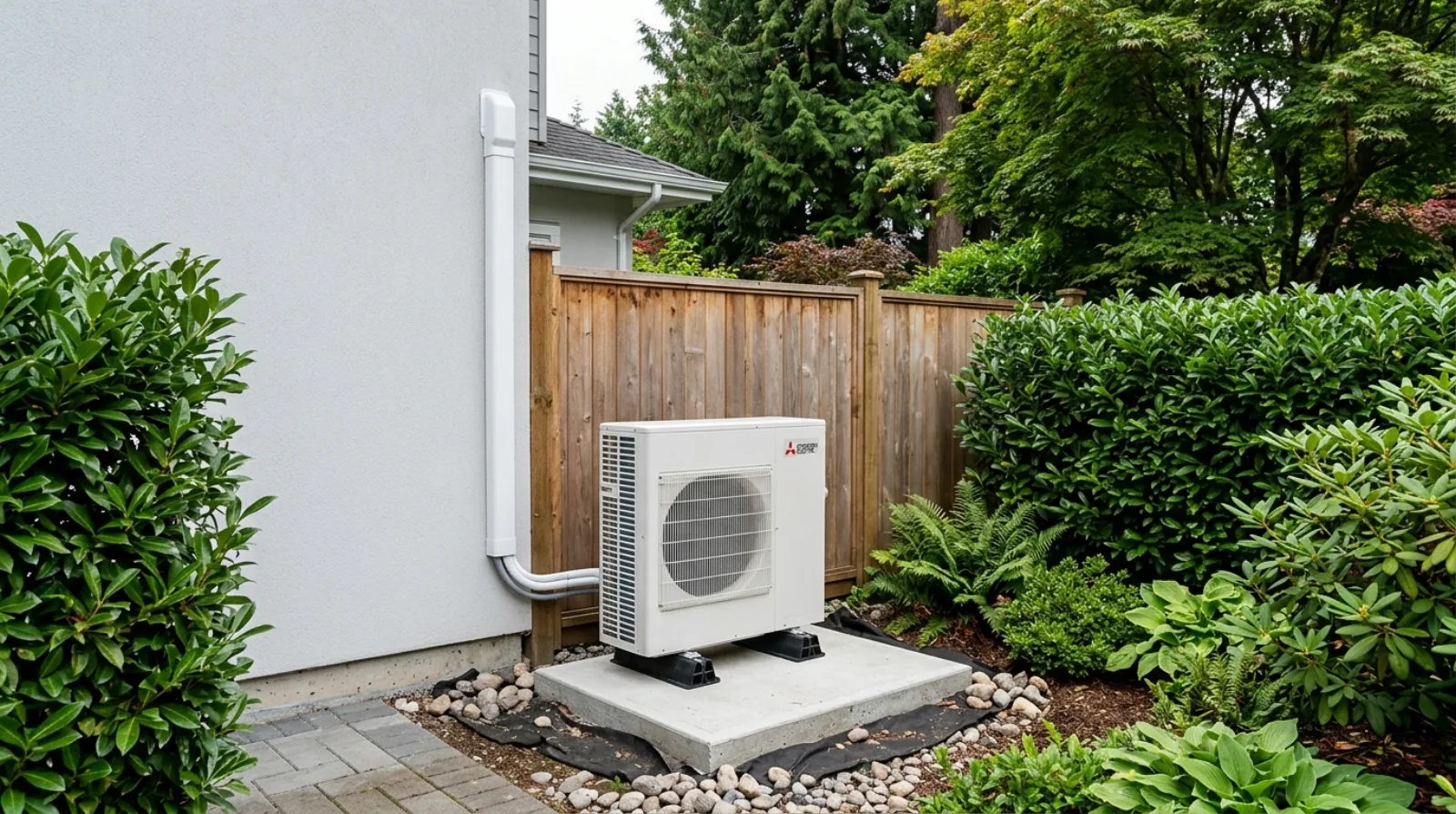
Those numbers are tighter than they sound. A typical quality heat pump has a sound power rating around 60 dB(A) at full output, and the 45-decibel night limit applies at the property line, right when the unit is working through a cold night. Both municipalities' guidance says the same things we tell clients: choose a quiet unit with variable-speed components and a night mode, avoid the side yard in favour of the front or rear, keep the unit away from neighbouring bedroom windows, mount it on a ground-level pad with rubber isolation rather than on a wall, and use fences or landscaping to break the line of sight, because if you can see it, you can usually hear it.
On the North Shore's narrow side yards, placement is worth an extra hour of thought at design stage. Relocating an outdoor unit after a neighbour complaint means new refrigerant lines, electrical, and a pad, at a cost that would have covered the quieter unit several times over. An oversized unit also short cycles, which is both noisier and harder on the equipment, so proper sizing quietly solves two problems at once.
Rebates in brief, and the step that protects them
The rebate picture in 2026 has two tiers, and the difference is large. The income-qualified CleanBC Energy Savings Program offers up to $13,000 toward a heat pump for households converting from gas, oil, propane, electric, or wood heat, plus up to $3,500 for a heat pump water heater and add-on support for electrical service upgrades. The standard Home Renovation Rebate program, open at any income and delivered through BC Hydro and FortisBC, offers up to $4,000, and in our region that standard-stream heat pump rebate applies to homes switching from electric heating. Check current eligibility before you count on any number, because these programs have changed repeatedly.
The step that protects your eligibility is the pre-retrofit EnerGuide evaluation, done before any work starts. Most rebate streams require the before-and-after assessment, and there is no way to create the baseline once the old furnace is gone. It costs about $600 for the pre and post visits together, takes a couple of hours on site, and we schedule it as the first line of the project plan on any retrofit where a rebate is in play. Also confirm the contractor requirement: some programs require a registered contractor from their network, and a rebate can be denied on that basis alone.
How we run a retrofit
Our sequence on a North Shore heat pump retrofit is fixed because every step feeds the next: EnerGuide baseline first, then the electrical load calculation, then envelope work worth doing before sizing, then equipment selection with the noise placement drawn on the site plan, then permits, installation, and the post-retrofit evaluation that releases the rebate. Run in that order, there are no surprises. Run out of order, the surprises arrive as change orders.
If your furnace is past 15 years old or your baseboards are what stand between you and a comfortable summer, the retrofit conversation is worth having before the equipment fails. A heat pump chosen in a heat wave or a cold snap is chosen badly, and the good installers on the North Shore book out just like every other trade here. Plan it as a project, not an emergency, and the numbers in this article are what it costs.
Frequently asked questions
Do heat pumps work well in North Vancouver's winter climate?
Yes. North Vancouver winters rarely drop below minus 5 Celsius, and air-source heat pumps run at their best between 0 and 10 degrees, which covers most of the local heating season. Modern cold-climate units operate down to minus 25 or minus 30, so a properly sized unit handles a North Shore winter without backup electric resistance heat, and operating costs run roughly 40 to 60 percent below a gas furnace per unit of heat.
Should an older North Shore home get a ducted or ductless heat pump?
The house's era mostly decides. Homes built in the 1960s to 1980s with a furnace and full ductwork, common in Lynn Valley, Edgemont, and Delbrook, suit a ducted heat pump that replaces the furnace and reuses the ducts. Homes with electric baseboards or radiators and no ducts, like many 1950s bungalows and West Vancouver mid-century houses, get ductless mini-splits zone by zone, usually keeping some baseboards as backup for closed-door rooms.
How much does a heat pump installation cost on the North Shore in 2026?
A ducted cold-climate heat pump runs $12,000 to $30,000 installed: straightforward installs reusing good ductwork land at $12,000 to $20,000, and full gas furnace replacements with duct modifications run $18,000 to $30,000. A single-zone ductless unit runs $4,000 to $9,000, a 3 to 4 head multi-zone system $15,000 to $25,000, and a heat pump water heater added at the same time $3,500 to $8,000.
Can a 100-amp panel support a heat pump?
Sometimes. Most pre-1990 North Shore homes run 100-amp service, and whether a heat pump fits depends on the electrician's load calculation, not a guess. A right-sized unit with load management can work at 100 amps, especially when the range and dryer stay on gas. Otherwise a 200-amp upgrade runs $3,000 to $5,000 for a straightforward swap, up to $9,000 when the mast, meter base, or service run needs replacing, and the utility side runs on BC Hydro's schedule.
What are the noise limits for heat pumps in North Vancouver?
The City of North Vancouver's Noise Control Bylaw No. 8885 and the District of North Vancouver's Noise Regulation Bylaw 7188 both limit residential noise to 55 decibels in the day and 45 decibels at night, measured at the property line, with night starting at 8 p.m. In the District, daytime starts at 9 a.m. on Sundays and statutory holidays. Since quality heat pumps are rated around 60 dB(A) at full output, unit selection and placement are what keep an install compliant.
Where should a heat pump outdoor unit be placed on a North Shore lot?
As far from the property line as possible, in the front or rear yard rather than the narrow side yard, away from neighbouring bedroom windows, and on a ground-level concrete pad with rubber isolation rather than wall-mounted. Both North Vancouver municipalities publish this guidance, and their rule of thumb is blunt: if a neighbour can see the unit, they can usually hear it, so use fences or landscaping to break the line of sight.
Why do some ducted heat pump retrofits underperform in older homes?
Because 1960s and 1970s ductwork was sized for a furnace delivering hotter air than a heat pump does, and it leaks. Pushing a heat pump through undersized, leaky ducts produces weak airflow and disappointing comfort, which gets blamed on the technology. Testing the ducts and resealing or upsizing sections during the retrofit is part of doing the job properly.
Should insulation or air sealing come before a heat pump?
Yes, where the house needs it. A 1970s North Vancouver home typically leaks 6 to 12 air changes per hour, and a leakier house needs a bigger, more expensive heat pump. An air sealing package runs $2,500 to $7,000 and an attic insulation top-up $2,000 to $4,000, and doing that work first sometimes drops the heat pump a full equipment size. Seal and insulate, then size the unit.
What heat pump rebates are available in BC in 2026?
The income-qualified CleanBC Energy Savings Program offers up to $13,000 toward a heat pump for conversions from gas, oil, propane, electric, or wood heat, plus up to $3,500 for a heat pump water heater. The standard Home Renovation Rebate program, open at any income through BC Hydro and FortisBC, offers up to $4,000, applying in our region to homes switching from electric heating. Programs change, so confirm current amounts before budgeting around them.
What has to happen before a heat pump retrofit to keep rebate eligibility?
A pre-retrofit EnerGuide evaluation, booked before any work starts. Most rebate streams require the before-and-after assessment, and once the old furnace is out there is no way to recreate the baseline. The pre and post visits together cost about $600. Also confirm whether your program requires a registered contractor from its network, because a rebate can be denied on that alone.
Do I have to remove my gas service to install a heat pump?
No. In a typical gas furnace replacement, the furnace gas line is capped and the meter stays for the range or fireplace, with the heating load moving to electricity. Many North Shore owners run this hybrid arrangement. The Zero Carbon Step Code is steering new construction and major additions away from gas heating, but a retrofit can keep gas appliances the owner wants.
Are heat pumps replacing gas furnaces in new North Shore construction?
Largely, yes. The Zero Carbon Step Code, available for BC municipalities to adopt since May 2023, ties emissions limits to space heating and hot water, and heat pumps are the straightforward compliance path. New construction and major additions on the North Shore have mostly stopped installing gas furnaces, which is also why retrofit expertise in older homes has become its own specialty.
Related service
Home Renovation
See how we handle home renovation projects across the North Shore.
Learn about home renovation