








The short answer
Any wall, floor, or crawl space that has been wet needs to be inspected for mould before renovation work covers it up. Health Canada treats a single mould patch larger than 3 square metres, about the size of a queen mattress, as a job for a qualified professional rather than DIY cleanup. Mould can begin growing within 48 hours of a leak, so a musty smell, past flooding, or a stain on the underside of subfloor are reasons to test before framing, insulating, or drywalling over the area.
How fast mould actually starts
Health Canada's guidance on indoor moisture and mould states plainly that mould will begin to grow in an area with excessive moisture within 48 hours. That number is worth sitting with, because it means the two-day window after a leak, a burst pipe, or a flooded crawl space is the period that decides whether the damage stays a drying job or becomes a remediation job.
This is precisely why a pre-renovation moisture check matters even when nothing looks obviously wrong. A leak from twenty years ago that was mopped up and never opened up again had its 48 hours long before you owned the house. The water is gone. What it left behind, if the framing stayed damp for any length of time afterward, did not go anywhere on its own.
When it is a wipe-down and when it needs a professional
Health Canada sets out size thresholds that are genuinely useful for a homeowner trying to judge what they are looking at. A small mould problem, three or fewer patches with a combined area under 1 square metre, can generally be cleaned up with proper precautions: gloves, an N95 respirator, and the affected material removed or scrubbed with detergent, not bleach alone.
A medium problem, more patches or a combined area between 1 and 3 square metres, still allows cleanup with the same precautions but Health Canada recommends an expert assessment first, since a spreading pattern at that size often points to a moisture source that has not been fixed yet.
Once a single patch is larger than 3 square metres, roughly the size of a queen mattress laid flat, Health Canada's guidance shifts from DIY-with-precautions to recommending a qualified professional handle both the assessment and the cleanup. At that size, disturbing the material without containment risks spreading spores through the rest of the house, particularly once demolition and dust are already part of the plan.
| Extent | Health Canada guidance |
|---|---|
| 3 or fewer patches, under 1 m² total | Can generally be cleaned up with standard precautions (gloves, N95, detergent) |
| More patches, or 1 to 3 m² total | Expert assessment recommended before cleanup, though cleanup itself may still be DIY with precautions |
| A single patch over 3 m² | Qualified professional recommended for both assessment and cleanup |
Where WorkSafeBC's rules take over from Health Canada's
Health Canada's guidance is written for homeowners assessing their own house. Once a renovation crew is doing the work, WorkSafeBC's mould guidance applies instead, and it treats mould as a workplace hazard rather than a household nuisance. The core principle is the same hierarchy of controls used for any hazardous material on a job site: eliminate the moisture source first, contain the area, and only then rely on personal protective equipment such as a properly fit-tested respirator as a last line of defence, not the first one.
In practice, this means a contractor finding mould behind an opened wall does not simply mask up and keep demolishing. The moisture source, whether that is a failed flashing detail, a cracked perimeter drain, or condensation from an unheated crawl space, has to be identified and addressed, and depending on the extent of the growth, a trained abatement team may be brought in to remove affected material safely before the rest of the renovation proceeds around it.
This is also where mould overlaps with the hazardous materials survey required before demolition work in BC under WorkSafeBC's OHS Regulation. That survey is aimed primarily at asbestos and lead, but a competent surveyor walking a pre-1990s North Shore house is also the person positioned to flag a suspicious stain before the sledgehammer comes out, which is one more reason to treat that inspection as more than a box to check.
The North Shore conditions that create this problem
Three things converge here more than in most parts of the Lower Mainland. The rainfall is heavier and more sustained through the winter than most of Metro Vancouver, so any envelope weakness, a missing kick-out flashing, a failed sealant joint, undersized gutters, has more water pushed through it over a season. The housing stock skews older, with a meaningful share of North Shore homes built before rainscreen wall assemblies became standard practice, which means the original construction had less built-in tolerance for the water that does get in. And the terrain is steep enough that drainage design around foundations is unforgiving of the retrofit shortcuts a previous owner may have taken decades ago.
The combination shows up most often in three places: crawl spaces with historic grading or drainage problems, bathrooms where a shower pan or tile assembly failed slowly rather than all at once, and the base of exterior walls below grade where a perimeter drain has been undersized or has simply failed with age. None of these are things a homeowner walking through their own house every day is likely to notice, because the visible symptoms, a slightly musty smell, a bit of efflorescence on a foundation wall, a soft spot in a subfloor near a tub, are easy to explain away individually.
What we actually do when we find it mid-renovation
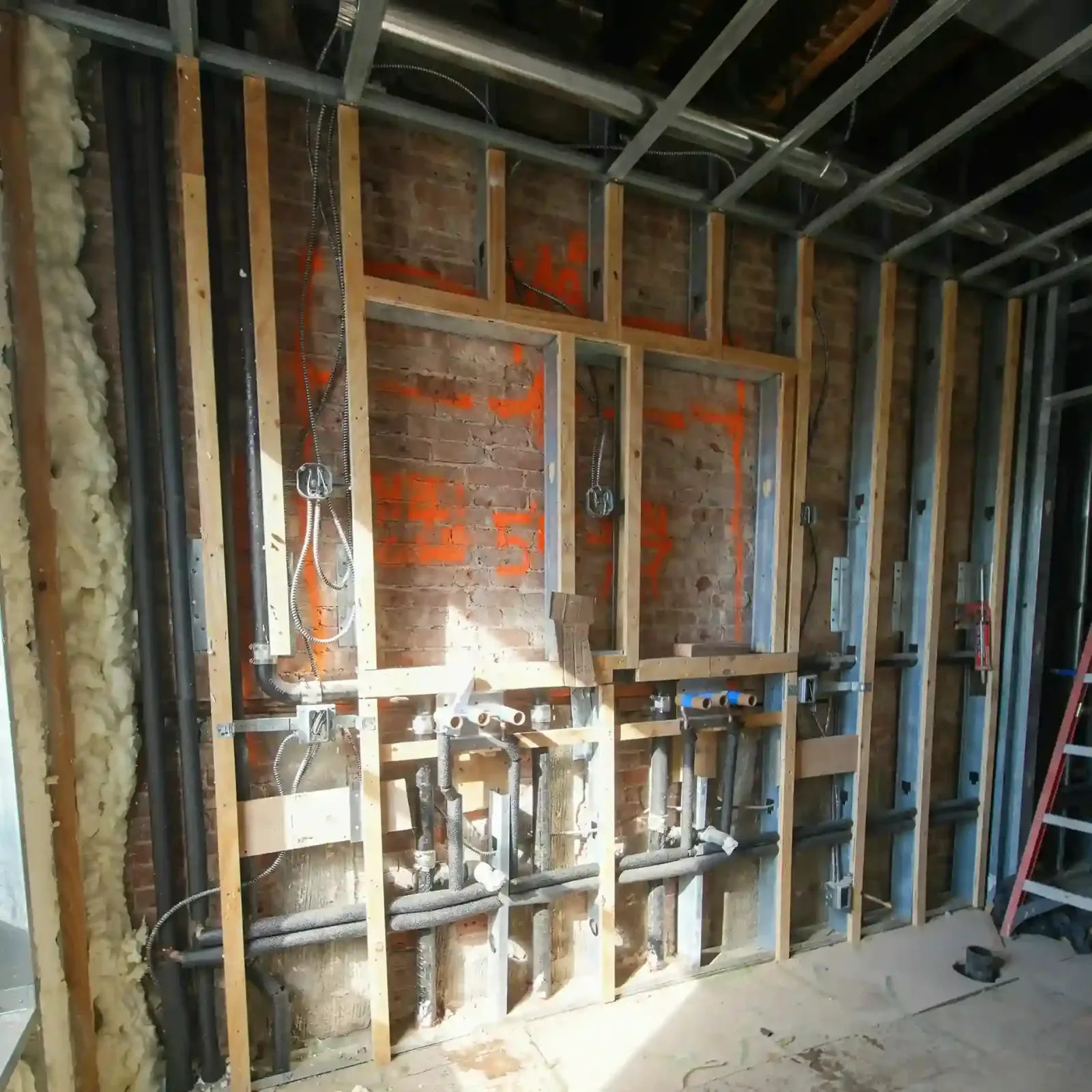
Finding water damage or mould after a project has started is not a reason to panic, but it is a reason to stop and reassess scope before continuing. The sequence that works is straightforward: identify the moisture source and confirm it is no longer active, assess the extent of any growth against something close to the Health Canada thresholds above, remove and dispose of affected porous material (drywall, insulation, and framing that cannot be dried and cleaned do not get reused), and let the area dry completely and get tested clear before new material goes back in.
The costly mistake is skipping the last step because it delays the schedule. New drywall over a stud bay that tested clear yesterday but was never actually confirmed dry is a bet against the same 48-hour mould clock the whole problem started with. On a renovation budget already carrying line items for permits, structural work, and finishes, the added cost of a moisture meter reading and a short delay before closing the wall is one of the cheapest insurance policies available on the entire job.
Sources
- Health Canada, Guide to Addressing Moisture and Mould Indoors. Source for the 48-hour mould growth timeline and the size thresholds distinguishing DIY cleanup from professional remediation.
- WorkSafeBC, Mould hazard guidance. Governs the hierarchy of controls, respiratory protection, and abatement team involvement once mould is encountered on a construction job site.
Frequently asked questions
How fast does mould grow after water damage?
Health Canada states that mould will begin to grow in an area with excessive moisture within 48 hours. That two-day window is why a leak or flood needs to be dried out immediately rather than left, and why any area that stayed wet for longer than that should be inspected before it gets covered by new renovation finishes.
Can I clean up mould myself, or do I need a professional?
It depends on the size. Health Canada guidance treats 3 or fewer patches under 1 square metre total as cleanable with standard precautions like gloves and an N95 respirator. Above that, and especially once a single patch exceeds 3 square metres, roughly a queen mattress, professional assessment and cleanup is recommended, since disturbing a larger area without containment risks spreading spores through the rest of the house.
Does renovation insurance cover mould remediation?
Not automatically. Some lower-cost renovation insurance policies specifically exclude mould remediation, so confirm coverage for this before work starts if your project involves an area with any history of water intrusion.
Can a contractor just drywall over a mouldy wall to save time?
No, and doing so makes the problem worse rather than resolving it. New drywall and insulation trap moisture against the framing behind them, and the mould keeps growing out of sight. Affected porous material, drywall, insulation, framing that cannot be dried and cleaned, needs to be removed, and the area needs to be confirmed dry before anything new is installed.
Why does the North Shore see more of this than other parts of Metro Vancouver?
Three factors combine here: heavier and more sustained winter rainfall than most of the Lower Mainland, an older housing stock that predates rainscreen wall assemblies, and steep terrain that makes foundation drainage design less forgiving of past shortcuts. The result shows up most often in crawl spaces, failed shower assemblies, and undersized or aging perimeter drains.
Does the WorkSafeBC hazardous materials survey check for mould?
The survey required under WorkSafeBC's OHS Regulation before demolition or renovation work is aimed primarily at asbestos and lead. A competent surveyor walking through an older home for that purpose is well positioned to also flag suspicious staining or moisture signs, but mould is governed separately under WorkSafeBC's mould hazard guidance rather than the hazardous materials survey requirement itself.
What is the moisture source I should look for first?
Start with the three places this shows up most often on North Shore houses: crawl spaces with historic grading or drainage problems, bathrooms where a shower pan or tile assembly has failed slowly, and the base of exterior walls below grade where a perimeter drain may be undersized or aging. The moisture source has to be found and fixed, not just the visible mould.
Should I get a moisture reading before closing up a wall after a renovation fix?
Yes. A moisture meter reading confirming the area is fully dry, not just visually clean, before new drywall or insulation goes back in costs very little against a renovation budget and protects against the same 48-hour mould growth window that likely caused the original problem.
Related service
Basement renovation & suites
See how we handle basement renovation & suites projects across the North Shore.
Learn about basement renovation & suitesWhere this applies
Related articles