


The short answer
A fixer-upper usually only beats a move-in-ready home when the purchase discount is 15% or more below comparable renovated homes, and when the renovation budget includes a realistic contingency of 10 to 15% for what's behind the walls. On the North Shore, that means running the numbers on inspection findings, financing structure, and code-upgrade triggers before you remove subjects, not after.
Start with the discount, not the dream
The entire fixer-upper thesis rests on one number: how much less are you paying than a comparable, already-renovated home in the same neighbourhood? If a renovated 2,400 sq ft home in Lynn Valley is trading at $1.9M and the dated version two doors down is listed at $1.7M, your discount is $200,000, about 10.5%.
That discount needs to cover your entire renovation budget, plus carrying costs during construction, plus a margin for error, or the fixer-upper isn't actually cheaper. It's just deferred spending with extra risk attached. As a rule of thumb, look for a discount of 15% or more against comparable renovated homes before the math starts to reliably work in your favour. Below that, you're often better off paying more upfront for a home that's already done, with a known price and no construction timeline.
Pull three to five recent comparable sales in the same neighbourhood, both renovated and unrenovated, before you make an offer. Your realtor can run this, or RealDream can walk the property with you and give a rough renovation range on the spot.
What the inspection actually needs to tell you
A standard home inspection on the North Shore checks the basics: roof, electrical panel, plumbing, visible structure, moisture signs. That's a starting point, not the full picture, especially on a pre-1980 home where the real cost drivers are often invisible from a walkthrough.
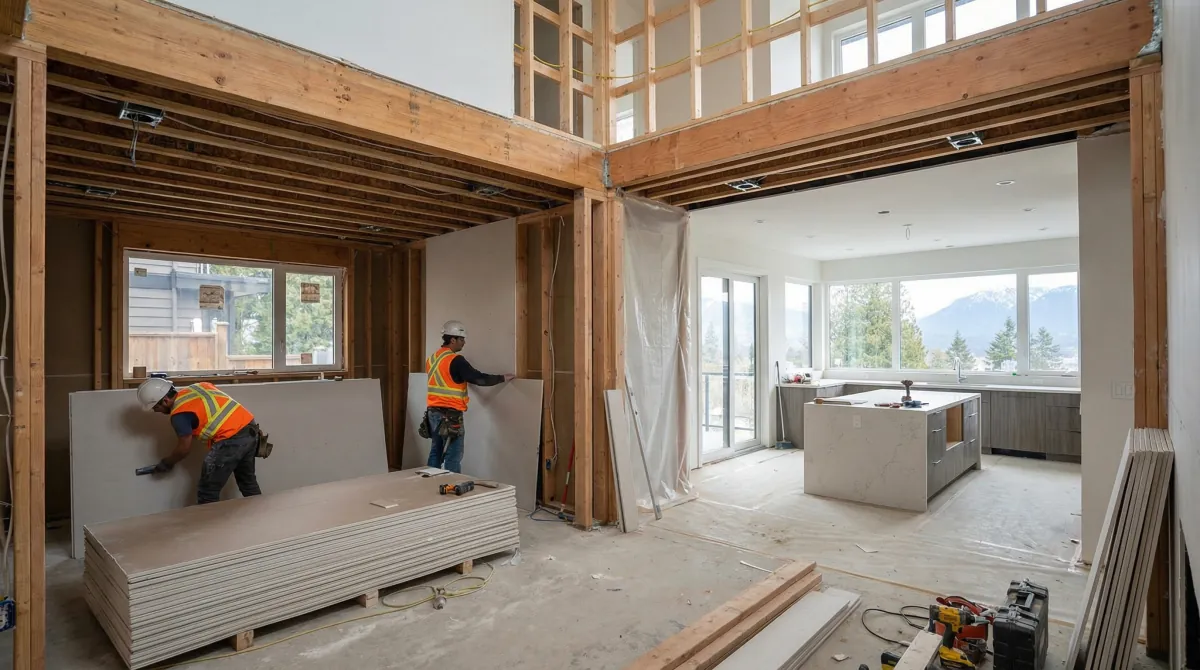
Before removing subjects on a fixer-upper, get a contractor's assessment alongside the standard inspection. RealDream's pre-construction site visits run 2 to 3 hours and specifically look at foundation condition, framing integrity, building envelope performance, mechanical system age, and any signs of moisture intrusion, which is the North Shore's most common and most expensive surprise given the rainfall here.
Ask specifically about knob-and-tube wiring (common in pre-1970 homes and a red flag for insurers), galvanized plumbing (corrodes from the inside and often needs full replacement), asbestos-containing materials (common in flooring, popcorn ceilings, and pipe insulation through the 1980s), and foundation cracking or settling on sloped lots.
- Foundation condition, especially on sloped North Shore lots
- Knob-and-tube wiring in pre-1970 homes
- Galvanized plumbing that corrodes from the inside
- Asbestos in flooring, ceiling texture, and pipe insulation
- Moisture intrusion in crawlspaces and around foundations
Price the code-upgrade trigger before you buy
Both the City and District of North Vancouver apply what's informally called the 50% rule: if your renovation cost exceeds roughly 50 to 75% of the assessed value of the building (not the land), the municipality can require the entire structure to be brought up to current BC Building Code standards. That includes seismic bracing, mechanical system upgrades, and building envelope work you may not have planned for.
This matters enormously for fixer-upper math, because it can turn a targeted $250,000 renovation into a $500,000-plus project once the trigger is crossed. Before you commit to a renovation scope, get a read on where your planned budget sits relative to the building's assessed value, and build the code-upgrade scenario into your worst-case number.
Build the real budget, not the optimistic one
Run the discount against the full budget including contingency and carrying costs, not just the base renovation quote. A fixer-upper that looked like a $150,000 discount can evaporate once carrying costs and a real contingency are added in.
| Line item | Typical range | Notes |
|---|---|---|
| Purchase discount vs. renovated comps | 10 to 20%+ | The whole thesis depends on this number |
| Contractor pre-purchase assessment | $0 to $1,500 | Some contractors, including RealDream, do this free for prospective clients |
| Renovation budget (mid-range whole home) | $200K to $400K | Based on 2026 North Vancouver pricing for a full mid-range renovation |
| Contingency for pre-1970 homes | 10 to 15% of renovation budget | Higher than the standard 5 to 10%, given the age of North Shore housing stock |
| Carrying costs during construction | $3K to $6K/month | Mortgage, insurance, utilities, and rent if you can't stay onsite |
| Code-upgrade trigger risk | +$50K to $150K | Only if renovation cost crosses the 50% threshold against assessed building value |
Financing a fixer-upper is a different conversation than financing a move-in-ready home
Most lenders will finance the purchase of a fixer-upper the same way they'd finance any resale home, based on current appraised value, not what it'll be worth after renovation. That means your renovation budget usually needs to come from a separate source: cash, a HELOC drawn against existing equity elsewhere, or a purpose-built renovation mortgage that some lenders offer, which bundles the purchase and renovation cost together with funds released in stages as work completes.
If you're planning a renovation heavy enough to trigger the 50% rule, some lenders will treat it closer to a construction loan, with higher rates and staged draws tied to inspection milestones. Get pre-approved for the renovation financing before you write the purchase offer, not after: discovering your renovation budget doesn't have a funding source partway through subject removal is a bad place to find that out.
The timeline cost people forget to price in
A move-in-ready home has a closing date and then you're living there. A fixer-upper has a closing date, then a design and permitting phase, then a construction phase, and only then are you living there. On the North Shore, permit processing for anything involving structural changes runs 4 to 8 weeks in the City of North Vancouver and 6 to 10 weeks in the District, before construction even starts. A full renovation adds 8 to 14 months from design start to move-in.
If you're renting or carrying a second home during that stretch, that's real money: often $2,500 to $4,500 a month in Metro Vancouver rental costs, which needs to be part of the comparison against buying move-in ready, not treated as a footnote.
When the fixer-upper math actually works
It works when the purchase discount clears 15% against genuinely comparable renovated homes, when a contractor's pre-purchase assessment doesn't turn up foundation or major structural issues, when your planned renovation scope stays clear of the 50% code-upgrade trigger, and when you have renovation financing lined up before you write the offer.
It works especially well when the lot itself is the asset: view lots, larger parcels, or properties in tightly held neighbourhoods like Edgemont, Deep Cove, or the British Properties, where land value carries most of the price and the existing structure's condition matters less to the long-term math.
It works less well when the discount is thin, when the inspection turns up foundation or envelope problems, or when your budget has no contingency margin. In those cases, a move-in-ready home at a higher purchase price, with a known total cost and no construction risk, is often the better financial decision even though it doesn't feel like a deal on paper.
Get the assessment before the offer, not after
The single biggest mistake we see is buyers who fall in love with a listing, write the offer, and only bring in a contractor for a real assessment after subjects are close to expiring, when there's pressure to move forward regardless of what the assessment finds.
RealDream will walk a North Shore property with you before you write an offer, or during your inspection period, and give you a realistic renovation range along with a flag on anything that looks like a structural or code-upgrade risk. That conversation costs you nothing and can save you from a purchase decision you'd regret six months in.
Sources
Frequently asked questions
How much of a discount should a North Shore fixer-upper have to be worth buying?
Look for a purchase discount of 15% or more against comparable, already-renovated homes in the same neighbourhood. Below that threshold, the discount often doesn't cover the full renovation budget plus contingency and carrying costs, which means a move-in-ready home at a higher price can work out to a similar or lower total cost.
What is the 50% rule and how does it affect fixer-upper renovations?
If your renovation cost exceeds roughly 50 to 75% of the assessed value of the building (not the land), the City or District of North Vancouver can require the entire structure to be brought up to current BC Building Code standards, including seismic bracing and mechanical upgrades. This can turn a $250,000 renovation into a $500,000-plus project, so it needs to be priced in before you set your renovation budget.
Should I get a contractor's assessment before or after the home inspection?
Ideally both, and before subjects are removed. A standard home inspection checks the basics, but a contractor's assessment looks specifically at foundation condition, framing, building envelope performance, and mechanical system age, the details that drive renovation cost on pre-1980 North Shore homes. RealDream provides this assessment free for prospective clients considering a purchase.
How much extra contingency should I budget for an older North Shore home?
Budget 10 to 15% contingency for homes built before 1970, higher than the standard 5 to 10% recommended for newer homes. Older North Shore housing stock commonly hides knob-and-tube wiring, galvanized plumbing, and asbestos-containing materials that only surface once demolition starts.
Can I get a mortgage that covers both the fixer-upper purchase and the renovation?
Some lenders offer a renovation mortgage that bundles the purchase price and renovation cost into a single mortgage, with funds released in stages as work completes. Otherwise, most buyers finance the purchase at current appraised value and fund the renovation separately through a HELOC or cash. Get pre-approved for renovation financing before writing the purchase offer.
What are the most expensive surprises found behind walls in North Shore fixer-uppers?
Knob-and-tube wiring in pre-1970 homes, galvanized plumbing that corrodes from the inside and often needs full replacement, asbestos in flooring or ceiling texture common through the 1980s, and moisture intrusion in crawlspaces, which is especially common given North Shore rainfall. Any of these can add $10,000 to $50,000-plus once uncovered.
How long does a fixer-upper renovation take from purchase to move-in?
A full renovation typically takes 8 to 14 months from design start to move-in, including 4 to 8 weeks for permit processing in the City of North Vancouver, or 6 to 10 weeks in the District, before construction begins. Factor in rental or carrying costs during that window when comparing total cost against a move-in-ready home.
Does buying a fixer-upper make sense if I'm planning to sell within a few years?
It's riskier. The fixer-upper thesis depends on capturing a purchase discount and executing a renovation on budget and on schedule, both of which carry uncertainty. If you're likely to sell within 2 to 3 years, a move-in-ready home with a known total cost removes that construction and timeline risk from the equation.
Is a fixer-upper a better deal when the lot is the main asset?
Often, yes. On view lots, larger parcels, or properties in tightly held neighbourhoods like Edgemont, Deep Cove, or the British Properties, land value carries most of the purchase price, so the existing structure's condition matters less to the overall math. The fixer-upper case is weaker when the structure itself represents most of the property's value.
What should I ask a contractor to check before I write an offer on a fixer-upper?
Ask them to assess foundation condition, framing integrity, building envelope performance, mechanical system age, and any visible moisture issues, and to flag whether your intended renovation scope would trigger the municipality's 50% code-upgrade rule. Also ask for a rough renovation cost range so you can compare it against the purchase discount before subjects expire.
Related service
Home Renovation
See how we handle home renovation projects across the North Shore.
Learn about home renovationWhere this applies
Related articles