


The short answer
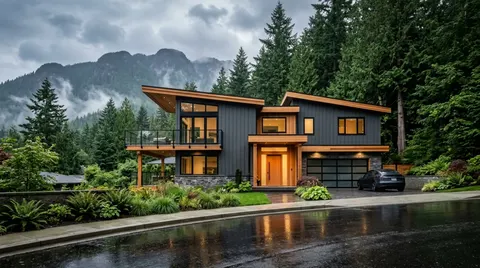
A whole-home renovation in Caulfeild, West Vancouver runs $250 to $350 per square foot, in line with the broader West Vancouver range, but rock excavation on the granite that underlies nearly every lot is priced separately by the cubic metre and requires a permit under the District's Blasting and Rock Breaking Bylaw No. 5130. Exterior changes in Lower Caulfeild, a provincially significant Heritage Conservation Area, also go through design review before the District issues a permit.
A village designed to look unplanned
Francis William Caulfeild, an Englishman who bought land here in 1899, spent the next three decades laying out a village the way he'd seen them grow at home: streets that bend with the terrain, lots that respect the rock and the trees, and public access to the shoreline built in from the start. He set the development pattern between 1899 and 1934, donated roughly 25 hectares for parkland, and gave the site for St. Francis-in-the-Wood church before returning to England in 1926.
That plan is genuinely lovely to walk through. It's also awkward to build in. Roads like Pilot House Road and the lanes around Caulfeild Cove are narrow, curved, and short on staging space. A standard concrete truck or a 40-foot material delivery does not simply pull up in Lower Caulfeild the way it would in a 1980s subdivision. We plan deliveries here the way we do in Deep Cove: smaller loads, early time slots, and a staging plan agreed before demolition starts, not discovered on delivery day.
Lower Caulfeild's heritage review: what it actually changes
Lower Caulfeild is a Heritage Conservation Area, the first of its kind in BC. That's not a plaque on a wall. It's a review layer with teeth. Exterior changes here go through a heritage review process before the District issues permits, and the review looks at how the work fits the established village character: rooflines, materials, siting, and the relationship to the street.
In practice, this adds design time up front rather than construction time later. Interior renovations are generally straightforward and don't trigger the review at all. The projects that need care are additions, new garages, window replacements that change the look of a street-facing elevation, and anything visible from Caulfeild Cove. We build the review into the schedule from day one, as a design phase step, so it's a known part of the timeline instead of a surprise that shows up after drawings are done.
The streets around St. Francis-in-the-Wood, with its stone-and-timber cottage architecture completed through the 1930s, hold their character and their value precisely because this review exists. Owners here are custodians of something scarce, and most of them already know it.
Granite changes what excavation means
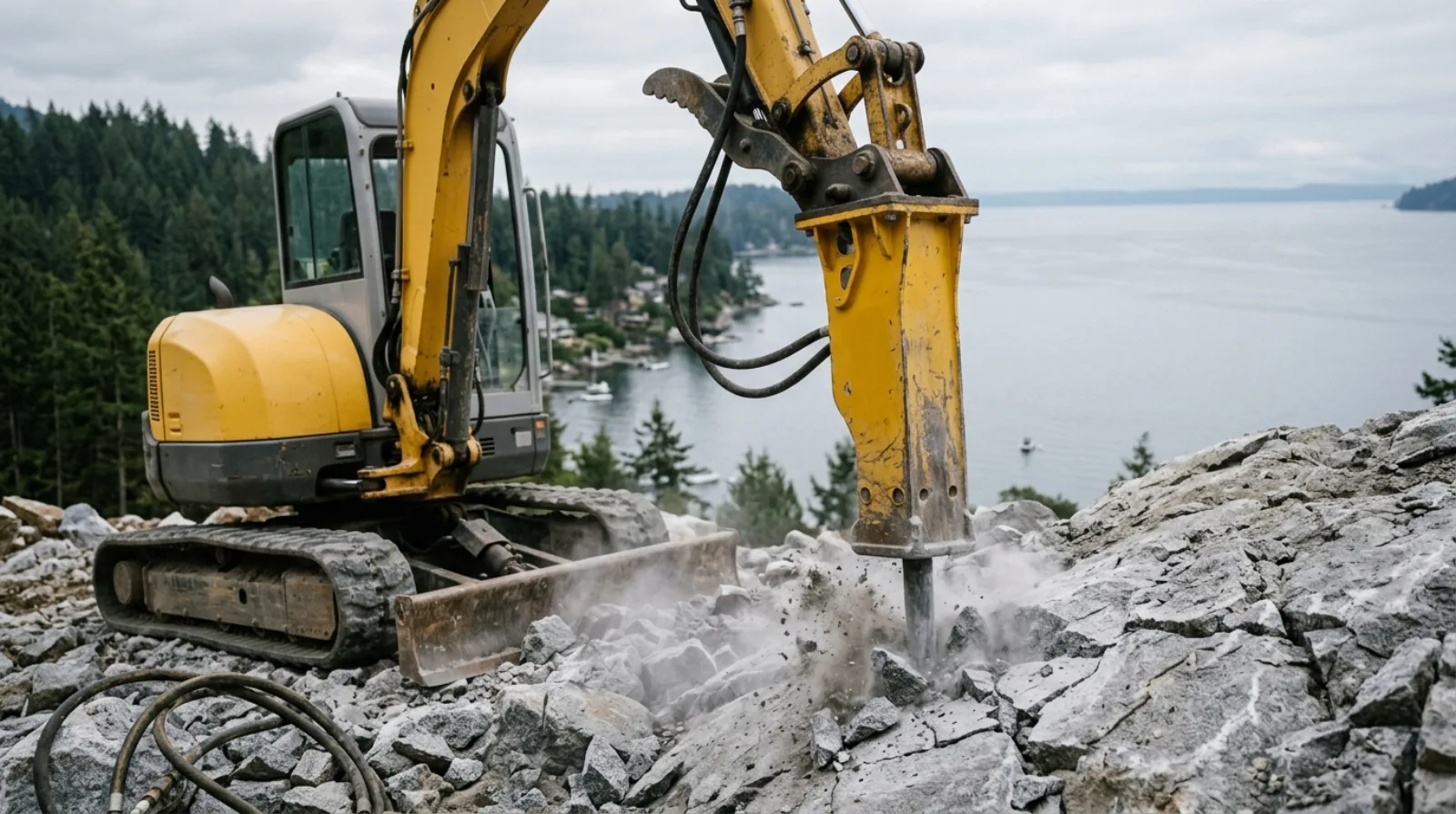
Almost every Caulfeild lot sits on granite. The arbutus trees that lean out over the waterfront grow straight out of it. That geology is why the views are this good, and it's also why excavation here is never ordinary digging. Lowering a basement slab, cutting a new foundation, adding a pool, or trenching for services all mean rock breaking, and sometimes blasting.
The District regulates this under its Soil Removal, Deposit, Blasting and Rock Breaking Bylaw No. 5130, 2021, which is more prescriptive than most municipalities because so much of West Vancouver is built on the side of the Coast Mountains. A blasting permit requires a building permit already issued and in good standing, a WorkSafeBC blasting certificate for everyone firing the shot, and a pre-blast topographic survey with volume calculations. Rock hammering isn't a permissible removal method anywhere in the District at any time. It's blasting under a blasting permit, or drilling, splitting, or percussive breaking under a rock-breaking permit capped at 45 cubic metres.
Rock work is priced by the cubic metre, and it makes ordinary excavation look cheap by comparison. So we scope it honestly before design locks. Moving a proposed addition three metres can sometimes cut the disturbed rock volume in half, which is a decision worth making on paper rather than after a drill rig is already on site.
Water moves across rock instead of into it
Drainage matters everywhere on the North Shore, but granite makes it a different kind of problem in Caulfeild. Water sheets across the rock instead of soaking into it, so runoff concentrates wherever the granite happens to direct it, sometimes straight at a foundation that was never designed for that volume. The District routinely requires drainage upgrades when a renovation expands footprint or hard surface, and on Caulfeild's rocky slopes, drainage and retaining scopes of $30,000 to $100,000 are common on larger projects.
This is the kind of cost that doesn't show up on a generic per-square-foot estimate, and it's exactly why we walk the lot before pricing anything. A quote built on flat-lot assumptions is a quote that changes once the excavator finds the first ledge of rock.
Two housing stocks in one neighbourhood
Lower Caulfeild holds the older character homes, some tracing back to the village's early decades, most renovated in waves since. Above it, the Caulfeild Plateau is a different animal entirely: roughly 270 acres just north of the old village were subdivided during West Vancouver's 1970s and 80s growth period, and the family homes around Headland Drive largely date from that era.
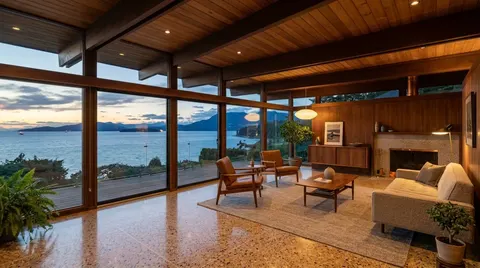
The 1970s and 80s stock is where most of our Caulfeild work actually happens. These houses have good size and good bones, but the original envelope predates rain screen construction, the windows are often first-generation double glazing with failed seals, and mechanical systems are at end of life. On the exposed southwest-facing lots, wind-driven rain off Howe Sound tests every flashing detail, which is why envelope upgrades here are never cosmetic. Kitchens and primary bathrooms from that era rarely match how people actually live now, which is why full kitchen renovations in the $90,000 to $150,000 band are our most common Caulfeild project.
Getting trades and materials this far west
Caulfeild is served by Exit 4 on Highway 1, at Woodgreen Drive and Headland Drive. The exit numbers along this stretch count kilometres east of Horseshoe Bay, which tells you Caulfeild sits near the far western end of the highway. For trades based in North Vancouver, that's a meaningful run each way, twice a day, on every trip.
We manage that with logistics rather than a travel surcharge. Deliveries get consolidated so a supplier comes once with a full load instead of three times with partial ones, trades are booked in longer blocks so a plumber finishes a full phase in one mobilization, and Caulfeild Village Shopping Centre on Headland Drive means crews aren't driving back to Park Royal for lunch or last-minute hardware. It's a small thing on paper. Over a six-month project, it's real hours saved.
What we take on in Caulfeild
Whole-home renovations, kitchen and bathroom renovations, envelope and window replacement, basement work where the rock allows it, and renovation design make up our Caulfeild work. Heritage review in Lower Caulfeild, the District's blasting and rock breaking rules, and the realities of building on granite near salt water are all conditions we plan for at the first site visit, not discoveries partway through construction.
Frequently asked questions
Do I need heritage approval to renovate a home in Lower Caulfeild?
If the work changes the exterior, yes. Lower Caulfeild is a Heritage Conservation Area, the first established in BC, and exterior changes go through a heritage review before the District of West Vancouver issues permits. Interior renovations are generally straightforward, but additions, garages, and street-facing window changes all get reviewed against the established village character.
Will my Caulfeild renovation need blasting or rock breaking?
It depends on how much the design disturbs the granite that underlies nearly every Caulfeild lot. Lowering a basement slab, cutting new foundations, pools, and service trenches commonly need rock breaking or blasting, regulated under the District's Bylaw No. 5130, 2021. We establish where the rock is before design locks, since shifting an addition a few metres can cut the disturbed volume significantly.
What does a blasting permit require in West Vancouver?
A blasting permit requires a building permit already issued and in good standing, a WorkSafeBC blasting certificate for every person completing the blast, and a pre-blast topographic survey with volume calculations. Rock hammering is not permitted anywhere in the District at any time; removal happens by blasting or by drilling, splitting, or percussive breaking under a rock-breaking permit capped at 45 cubic metres.
Who was Francis Caulfeild, and why does his 1899 village plan still matter?
Francis William Caulfeild bought land here in 1899 and spent three decades laying out winding streets that followed the terrain instead of a grid, donating land for parkland and for St. Francis-in-the-Wood church before returning to England in 1926. That plan is why roads like Pilot House Road in Lower Caulfeild are narrow and curved today, with little staging room for concrete trucks or long material deliveries, so we plan smaller loads and early delivery slots on every project there.
How much does rock excavation add to a Caulfeild renovation?
Rock work is priced by the cubic metre and costs several times what ordinary excavation does, so the honest answer depends on volume. That's why we scope rock before design rather than after. Related drainage and retaining work on Caulfeild's rocky slopes commonly adds $30,000 to $100,000 on its own, separate from the rock removal itself.
When were most Caulfeild homes built?
The Caulfeild Plateau, roughly 270 acres north of the old village, was subdivided during West Vancouver's 1970s and 80s growth period, and most homes around Headland Drive date from that era. Lower Caulfeild is older, with character homes tracing back to the village Francis Caulfeild laid out between 1899 and 1934.
What typically needs replacing in a 1970s or 80s Caulfeild house?
The building envelope is the big one. Cladding from that era predates rain screen construction, and first-generation double-glazed windows usually have failed seals. Mechanical and electrical systems are at end of life, and kitchens and bathrooms rarely match how people live now. On exposed southwest-facing lots, wind-driven rain off Howe Sound makes envelope work the priority rather than a cosmetic afterthought.
What does a kitchen renovation cost in Caulfeild?
A full mid-range kitchen renovation in Caulfeild runs $90,000 to $150,000 over 10 to 16 weeks, consistent with West Vancouver pricing generally. Custom millwork, stone slab surfaces, and panel-ready appliances push past $200,000. Plateau-era kitchens usually need an electrical upgrade as part of the scope, since the original panels weren't sized for modern appliance loads.
Why does drainage matter so much on a granite lot in Caulfeild?
Because water sheets across granite instead of soaking into it, so runoff concentrates wherever the rock directs it, sometimes straight at a foundation. The District of West Vancouver routinely requires drainage upgrades when a renovation expands footprint or hard surface, and on Caulfeild's rocky slopes, drainage and retaining scopes of $30,000 to $100,000 are common on larger projects.
How does highway access work for construction deliveries to Caulfeild?
Caulfeild is served by Exit 4 on Highway 1, at Woodgreen Drive and Headland Drive. Exit numbers on this stretch count kilometres east of Horseshoe Bay, which tells you Caulfeild sits near the far western end of the highway. We consolidate deliveries and book trades in longer blocks so the distance costs hours over a project, not weeks.
What does a whole-home renovation cost in Caulfeild?
A whole-home renovation in Caulfeild runs $250 to $350 per square foot over 8 to 16 months, in line with the broader West Vancouver range. Lower Caulfeild projects add heritage review time to the schedule up front, which we treat as a design phase step rather than a construction delay, so it doesn't come as a surprise partway through the project.
Related service
Home Renovation
See how we handle home renovation projects across the North Shore.
Learn about home renovationWhere this applies
Related articles